Tag books (69)
Antifragile review
Mood: tired
Posted on 2014-09-21 12:57:00
Tags: reviews books
Words: 645
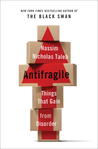 Antifragile: Things That Gain from Disorder by Nassim Nicholas Taleb
My rating: 2 of 5 stars
Maaaan this book was frustrating to read.
His main point is that some things are fragile - small random things happening to them make them break. Some things are robust - they're resilient to small random things happening to them. But the best things are antifragile - small random things happening to them make them stronger. Good examples are things like your immune system, since being exposed to weak viruses makes it stronger.
So far so good. Unfortunately the rest of the book was painful to read, even as there were some good ideas sprinkled within. Here are some reasons why!
- The author is, to put it delicately, an egocentric asshole. He calls things "sissy" and "wussy", because he's apparently a fifth grader. Some choice quotes:
A friend who writes books remarked that painters like painting but authors like "having written." I suggested he stop writing, for his sake and the sake of his readers.
Charming, no? He also goes on about people who just don't understand his ideas (which I'm a little skeptical of...it's possible that they do understand and disagree, which I'm sure the author would consider the same as not "really" understanding) and gives the example of a time when he was doing a radio interview and the journalist didn't understand something, so he walked out of the studio.
- The book is extremely prone to overstating things for dramatic effect (I assume?), which made me not trust it in a lot of cases. The author says "I realized school was a plot designed to deprive people of erudition by squeezing their knowledge into a narrow set of authors." (and then has a long list of authors that he's read) He says depression is a made-up disease! Here, look:But when you medicate a child for an imagined or invented psychiatric disease, say, ADHD or depression, instead of letting him out of the cage, the long-term harm is largely unaccounted for.
I mean, I don't disagree that ADHD is probably overdiagnosed and we need to be careful about prescribing medication, especially if it isn't proven to work better than counseling. But I think it's pretty unreasonable and insulting to say depression is "imagined or invented". To me, this shows a lack of empathy or a belief that since he doesn't feel depressed, other people are just "sad" or faking it or something. Sigh.
- He has a giant chip on his shoulder. In retrospect this isn't terribly surprising, because in "The Black Swan" he talks about betting for the market to crash and being wrong every day for a long time, until he was right. (it also isn't surprising because he's an egocentric asshole - see above) But he attacks people mercilessly, some of whom seem like they don't deserve it. He keeps calling people "Fragilista" (which I never was entirely clear what that meant) and he talks about about "Soviet-Harvard" people. He is extremely condescending towards "book learning" and claims that most innovations came from tinkering without understanding what was going on, which I find a bit implausible.
- The book is extremely hedgehog like (see The Hedgehog and the Fox) - he tries to apply this principle of antifragility across a wide range of topics, some of which he (proudly!) doesn't know much about.
He also hates the metric system because the imperial measures are "intuitive". For example, a furlong is the distance one can sprint before running out of breath, which is really stretching the definition of intuitive...
Anyway, with most books I try to ignore the parts I don't like and get what I can out of it. In this case the whole reading experience was pretty unpleasant, and 90% of the good parts were in "The Black Swan" anyway, so I'd recommend reading that instead.
View all my reviews
0 comments
Red Rabbit review
Mood: relaxed
Posted on 2014-09-16 21:56:00
Tags: reviews books
Words: 154
 Red Rabbit by Tom Clancy
My rating: 3 of 5 stars
I thought the book was pretty good, although in retrospect it was kind of repetitive. Some other things I didn't like:
- The book was written in 2002 but set in 1982 (a sort of prequel), and it gets way too clever about "predicting the future": Jack Ryan thinks that Japan is going to go into recession! He invests in Starbucks! He has a good feeling about Cal Ripken, Jr! (and all of these get mentioned multiple times) I understand the temptation to do this, but do it more than once and it just gets irritating and takes me right out of the book.
- I'm guessing that Clancy was a bit right-wing (which, admittedly, isn't a huge surprise), and while I haven't seen his biases show in previous books they certainly do in this one, often for seemingly no reason.
View all my reviews
0 comments
The Gendered Society review
Mood: relaxed
Posted on 2014-09-14 20:59:00
Tags: reviews books
Words: 166
 The Gendered Society by Michael S. Kimmel
My rating: 5 of 5 stars
I got sent a copy of this book because it uses a version of my same-sex marriage map, so when I got it I flipped through to find it and then set it aside. David read through it and liked it a lot, so I decided to give it a read through, and it's really quite good!
The author's main points are:
- gender differences are quite exaggerated - there's much more variability inside a gender than between them. (think of two bell curves with slightly different means, or something like that)
- It sure seems like gender inequality is the cause of (and not a result of!) the differences between genders.
The book can be a bit depressing because people are terrible, but it's a good look at what gender means, and it opened my eyes into how much society constructs and enforces gender roles. And gender roles make me angry!
View all my reviews
0 comments
Everything is Bullshit review
Mood: exhausted
Posted on 2014-09-13 20:59:00
Tags: reviews books
Words: 148
 Everything Is Bullshit: The greatest scams on Earth revealed by Alex Mayyasi
My rating: 3 of 5 stars
I really enjoy the Priceonomics blog, so I was happy to support them even though this is just a collection of essay from the site.
Some of these I considered pretty obvious (demand for diamonds was created by DeBeers! Companies that make packaged foods lobby Congress a lot and get laws passed!), but there are definitely a few gems here. I specifically enjoyed the article about how a comedy writer became homeless (which honestly didn't have much to do with the book's premise, but was gripping and well-written), the donate cars for charity article, and the bicycle thief one.
So it all depends on what you know or have read before. I'd recommend it regardless and just skip to the next chapter if you get bored.
View all my reviews
0 comments
Profit from the Core review
Mood: relaxed
Posted on 2014-09-08 14:32:00
Tags: reviews books
Words: 160
 Profit from the Core: Growth Strategy in an Era of Turbulence by Chris Zook
My rating: 3 of 5 stars
This book was OKish. (I'd give it 2.5 stars if allowed to) The main thesis is that your business should figure out what it's good at and focus on that. When you want to expand, focus in adjacent markets where you can leverage what you're good at. The book is very down on diverse conglomerates.
Which is all fine and such, but the book itself was kind of dull and repetitive. Also, being written in 2001, it has some amusing bits:
- It quotes Mitt Romney! (the book was written by people at Bain)
- It isn't so sure how Amazon's move to sell other things than books is going to work.
- The best part was the few pages on how Enron(!) does so well! There's also a few positive mentions of WorldCom.
So...yeah. Grain of salt indeed!
View all my reviews
0 comments
The Innovator's Dilemma review
Mood: relaxed
Posted on 2014-09-06 20:56:00
Tags: reviews books
Words: 389
 The Innovator's Dilemma: The Revolutionary Book That Will Change the Way You Do Business by Clayton M. Christensen
My rating: 4 of 5 stars
This was a very engrossing book. I've started taking these business sorts of book with a grain of salt, but the book presents an interesting way of thinking that I'm pretty sure is right some of the time.
The basic idea is: established companies are great at coming up with "sustaining" innovations, which are innovations that improve on their existing technology. They are terrible at investing in "disruptive" innovations, which produce products that are worse than their existing products in ways that their customers care about, but better in a few that are crucial for customers they don't have yet. The example the book uses is disk drives in the 70s-80s - companies that made 14 inch drives were successful at increasing the density of those drives, but few/none made the jump to 8 inch drives. These 8 inch drives were more expensive per megabyte and smaller, but they were cheaper overall and more rugged, which their customers didn't care about but emerging products did.
This is combined with the trend that often technology improves faster than the market cares about, so eventually 8 inch drives caught up in capacity with what the existing market needed and soon after nobody bought 14 inch drives anymore.
The tricky part is that often established companies had the ability to make these disruptive innovations, but when they're being developed they generally have smaller margins since they're cheaper, so there's a strong incentive for companies to keep investing in the technologies they're familiar with and get higher margins. This works for a while until the disruptive innovation becomes good enough, and then the market collapses. Even if the company then tries to make the disruptive innovation, the companies that have been doing it for years are much better at it.
The author suggests that the only way established companies can successfully adopt a disruptive innovation is to basically let a group work on it that is guaranteed resources to continue their work and isolate them from the existing company, so the people can have the freedom to experiment without being pulled in to working on existing products.
Anyway, it's a fairly light read but very interesting!
View all my reviews
0 comments
No Requiem for the Space Age: The Apollo Moon Landings and American Culture review
Mood: stressed
Posted on 2014-08-12 20:18:00
Tags: reviews books
Words: 118
 No Requiem for the Space Age: The Apollo Moon Landings and American Culture by Matthew D. Tribbe
My rating: 2 of 5 stars
I did learn something from this book - the Apollo missions (really, the whole space race) were pretty controversial, and opposition to them came from both the left and right. In fact, a year after Apollo 11 less than half of the people in a poll could name Neil Armstrong as the man who first walked on the moon. (the number is higher now)
Other than that, though, the book was just kind of long and meandering and depressing. I'm not sure what I was expecting, I guess, but I was disappointed.
View all my reviews
0 comments
Capital in the Twenty-First Century review
Mood: okay
Posted on 2014-07-23 21:27:00
Tags: reviews books
Words: 495
 Capital in the Twenty-First Century by Thomas Piketty
My rating: 5 of 5 stars
This is a 700-page book about economics which...wait, come back! So yeah, it's pretty long, and I'd be lying if I said it was fun and games the whole way through. But it was quite interesting, and even surprisingly entertaining. It's also quite readable for a 700 page economics book. I'm not going to try and summarize the whole thing (I'd recommend reading one of the many other reviews for that) but here are a few bits I found interesting:
- Piketty talks about the works of Honore de Balzac and Jane Austin. He points out that inflation was low enough in the 19th century that their novels could have specific references to wealth and income and readers would be able to relate. Between 1914-1945 significant inflation was seen for the first time, and consequently you don't tend to see dollar amounts in books, etc.
- Income inequality in the US has been trending upward (higher than in most other countries), and Piketty believes it's because of the enormous rise of salaries of "super-managers" (i.e. CEOs) whose individual productivity is very hard to measure. After the Reagan tax cuts of the 1980s (when the top tax bracket was reduced from 70% to 28%) the "super-managers" had more of an incentive to try to increase their earnings. An argument one hears is that decreasing the top tax rate increased productivity growth, but that doesn't seem to be the case.
- Before 1914, wealth was very concentrated, but the shocks of World Wars 1 and 2 dramatically reduced the wealth of the top 10%, and it's only now starting to "recover". Similarly, before the World Wars, wealth was more concentrated in Europe than it was in the US, but since 1960 or so the reverse is true.
- One of the main theses of the book goes as follows: the rate of return on capital (which Piketty calls "r") in generally on the order of 4-5% per year. (I don't think there's a theoretical underpinning for this - it's just what has been measured for a long time) The rate of growth of world GDP (which Piketty calls "g"), while it has been as high as 3-4% in recent times, is usually lower, and he believes it will be lower in the future. This means that r>g, so wealth will continue to accumulate faster than people can earn it, so wealth will continue to become more concentrated.
- If you look at university endowments, it seems that the larger the endowment, the more return it tends to get. This is another factor that can lead to "the rich getting richer" effect.
- His solution to the problem of growing inequality is a global progressive tax on wealth. (not income)
Anyway, it really was a fascinating and surprisingly readable book, and I'd recommend it if you didn't run away screaming at the first paragraph of this review :-)
View all my reviews
0 comments
Paddle Your Own Canoe review
Mood: productive
Posted on 2014-01-11 15:31:00
Tags: reviews books
Words: 45
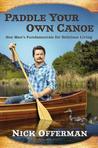 Paddle Your Own Canoe: One Man's Fundamentals for Delicious Living by Nick Offerman
My rating: 4 of 5 stars
This book is half memoir and half rules for living. I found it interesting although it wasn't as funny as I expected.
View all my reviews
0 comments
Because I Said So! review
Mood: productive
Posted on 2014-01-11 15:25:00
Tags: reviews books
Words: 109
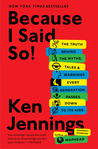 Because I Said So!: The Truth Behind the Myths, Tales, and Warnings Every Generation Passes Down to Its Kids by Ken Jennings
My rating: 4 of 5 stars
This is essentially Mythbusters for folk wisdom, some of which you probably heard when growing up. Some of these are clearly false (no, your face isn't going to freeze that way) but there are a lot of interesting ones too. (sitting up straight isn't necessarily better for your back, and mixing different kinds of batteries is bad) And it covers the whole "carrots make your eyesight better", which is my litmus test for a book like this.
View all my reviews
0 comments
An Astronaut's Guide to Life on Earth review
Mood: productive
Posted on 2014-01-11 15:15:00
Tags: reviews books
Words: 54
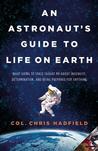 An Astronaut's Guide to Life on Earth by Chris Hadfield
My rating: 4 of 5 stars
Very good memoir - Col. Hadfield talks about his life and lessons he learned along the way. It was more memoir-y than space-y which I didn't expect, but I definitely enjoyed and would recommend it.
View all my reviews
0 comments
Days of Fire: Bush and Cheney in the White House book review
Mood: peaceful
Posted on 2013-11-28 19:47:00
Tags: reviews books
Words: 144
 Days of Fire: Bush and Cheney in the White House by Peter Baker
My rating: 4 of 5 stars
The book is quite long, but it has a lot of fascinating details about the Bush presidency. I was most interested in what it had to say about the whole Iraq war thing - what I took away was that there were people who were thinking about going to war with Iraq very soon after 9/11, and while the administration may not have falsified intelligence about WMDs, it was very clear what the White House wanted to find which probably had some influence on the CIA.
It also talks about how Cheney did have a lot of influence during his first term, but his influence definitely waned by the second term.
Anyway, I'd definitely recommend reading it, even at over 800 pages(!)
View all my reviews
0 comments
Scarcity: Why Having Too Little Means So Much review
Mood: happy
Posted on 2013-10-06 22:17:00
Tags: reviews books
Words: 506
 Scarcity: Why Having Too Little Means So Much by Sendhil Mullainathan
My rating: 4 of 5 stars
A fascinating book about how scarcity (especially in money or time) changes you. Some highlights:
- One experiment was run on people during World War II (conscientious objectors, apparently) where they ate very few calories for weeks. The point of the study was to figure out how to safely start feeding them normal amounts again, but during the experiment they had some personality changes - they became obsessed with cookbooks and menus, and focused on the scenes in movies where characters ate.
- Scarcity makes you tunnel on what you're lacking, at the cost of more long-term thinking.
- A school next to a loud railroad line showed that students nearest the noise were a full grade level behind those farthest away from the noise. Installing noise dampening pads caught them back up.
- Scarcity reduces your mental bandwidth (which the book defines as some combination of cognitive capacity and executive control)
- They were able to trigger scarcity by asking people to imagine they needed to make a $3000 car repair. After doing this, the lower-income people did significantly worse on a test of cognitive capacity, while the higher-income people didn't see such an effect. (the control was asking people to imagine they needed a $300 car repair, which didn't affect either group) This was even bigger than the effect on people who were forced to pull an all-nighter!
- Scarcity means you have to think of everything in terms of trade-offs - if I buy this $10 cocktail, that's $10 I don't have to buy something else. When you're not suffering from scarcity you don't tend to think that way as much.
- They looked at street vendors in India who have to borrow money at the beginning of the day to buy items to sell, and then pay back the daylong loan at the end of the day with the money they make during the day. This happens every day, and the interest rate they pay is 5% a day, which is of course really really high. So they ran an experiment where they gave a collection of vendors enough money to buy out their debt, so they wouldn't have to borrow every day. They wanted to see if the vendors would be able to not fall into the "scarcity trap" again (having to borrow every day). The result was interesting - the vendors didn't waste the money and were able to stay out of debt for a few months, but then one by one they all fell back into the scarcity trap. The reason was that while the vendors weren't in debt anymore, they had no slack in their budget, and so the first time they had an unexpected expense they would fall back into debt.
Anyway, while the book gets a bit repetitive in its second half, I still enjoyed it a lot and it's definitely worth a read. The biggest takeaway: scarcity is bad, but slack can defeat it!
View all my reviews
0 comments
Top Dog: The Science of Winning and Losing review
Posted on 2013-04-09 20:39:00
Tags: reviews books
Words: 247
 Top Dog: The Science of Winning and Losing by Po Bronson
My rating: 3 of 5 stars
The book is all about competition and how it's generally a good thing - it makes most people perform better. Some tidbits:
- Apparently the "home field advantage" is a real thing, and covers a lot of weird situations - preschoolers playing a game are more likely to win if they're playing in their own classroom, for example.
- In general, it hurts to have people watching/cheering you on while you're learning a skill, but it helps after you've mastered it.
- In sports tournaments (i.e. golf and racing), the bigger the reward and the higher the spread between the 1st place and 2nd place rewards, the more aggressive they are.
- There's a specific genetic codon (COMT) that controls how well your brain handles stress, and thus what your optimal stress level is to get your best performance.
- There's a big difference between men and women when deciding to run for Congress - men will run if there's any chance of winning, while women won't unless they have at least a 20% chance or so.
- Girls tend to handle highly-competitive schools better than boys, because boys are more discouraged by repeatedly competing and losing.
Anyway, the book was decent, but I think it overgeneralized a bit. (there was a short bit about software development that I just rolled my eyes at) I think I might move on from neurotrash for a while.
View all my reviews
0 comments
Quiet: The Power of Introverts in a World That Can't Stop Talking review
Mood: happy
Posted on 2013-03-24 22:00:00
Tags: reviews books
Words: 628
 Quiet: The Power of Introverts in a World That Can't Stop Talking by Susan Cain
My rating: 4 of 5 stars
My friend Dan Hedges dubbed this category of books as "neurotrash", which I think is an excellent term. And yet, I keep reading and enjoying them, and I enjoyed this one more than most.
The gist of the book is that although the American ideal seems to be a friendly, extroverted person, introverts have a lot to offer. Here are some things I found interesting:
- The definition of an introvert is a bit fuzzy. Generally, introverts prefer less stimulation than extroverts, tend to work more slowly and deliberately, and enjoy having fewer, but closer, friends. They also need time alone to recharge, as opposed to extroverts who recharge by being around people.
I was pretty sure that I was an introvert before reading the book, and that's still the case. I do enjoy going out a little more than some others I know, and I enjoy traveling and meeting people, but only if there's a well-defined relationship between us. For example: going to NI events is good, because I can talk about LabVIEW with people and ask how they use it. Going to a bar is bad, because I don't know what on earth to talk about. (I am also extremely conflict-averse, another introverted trait)
- The book covers a lot of studies where introverts can be more effective than extroverts. One showed that it seems that introverts are better leaders when the people they're leading are initiative-takers, because they tend to be better listeners.
- I've read this before, but: group brainstorming is less effective than individual brainstorming. One reason is the fear of public humiliation, even if you try to defuse that by saying "all ideas are good ideas", etc. Interestingly, online brainstorming seems to work the best of all.
- The book talked about the study where if a person is in a group with three other actors, and the group is asked a question and the actors answer deliberately incorrectly, the person is more likely to give the wrong answer. (in one version, the person gave the correct answer 95% of the time when there were no actors, but only 25% of the time if all the actors confidently gave the wrong answer!) They then did a followup with an fMRI machine to try to figure out whether the people were knowingly giving wrong answers because of peer pressure, or whether their perception was actually being altered...and it seems like their perception was being altered! Crazy.
- Babies who are "high-reactive" (who react more strongly to new sights and sounds) tend to grow up to become introverts.
- A helpful tip for introverts and extroverts is to try to find your sweet spot for how much stimulation you like, and work to stay near it. Just keeping in mind that you have a sweet spot is helpful.
- It seems like what makes an extrovert an extrovert is a tendency to seek rewards (economic, political, hedonistic), because they experience more pleasure and excitement than introverts do. They get an extra buzz from achieving their goals.
- A study found that men who are shown erotic pictures just before they gamble took more risks than those shown neutral pictures. This surprises me not at all. (the lesson is: when making a big decision...don't look at erotic pictures?)
- It's a good idea to create "restorative niches" for yourself where you can relax and be yourself. (these can be physical places or specific times throughout the day)
- In general, introverts like people they meet in friendly contexts, while extroverts prefer those they're in competition with.
--
I enjoyed the book a lot and would recommend it if you're into neurotrash! :-)
View all my reviews
1 comment
The Eyre Affair review
Mood: okay
Posted on 2012-12-09 16:28:00
Tags: reviews books
Words: 33
 The Eyre Affair by Jasper Fforde
My rating: 5 of 5 stars
Delightful book. The premise is outlandish but the author really sells it well and sucked me in!
View all my reviews
2 comments
Why Nations Fail: The Origins of Power, Prosperity, and Poverty review
Mood: cheerful
Posted on 2012-09-23 16:23:00
Tags: reviews travel books
Words: 722
(I read this on vacation, and enjoyed it enough to write this review out longhand!)
 Why Nations Fail: The Origins of Power, Prosperity, and Poverty by Daron Acemoğlu
My rating: 4 of 5 stars
This book attempts to explain why there is such a huge difference in income and standards of living between countries. Its thesis is there are two kinds of economic institutions in a country: extractive, which extract incomes and wealth from one subset of society to another, and inclusive, which encourage participation for everyone and lets people make choices. There are also extractive and inclusive political systems, which correspond roughly to how democratic the system is. Extractive political systems are highly correlated with extractive economic systems, and these are the poorer countries.
A lot of the book examines particular countries and how they got the way they are. For example, because there were existing native civilizations in Mexico and Latin America when the conquistadors arrived, they were easily able to make an extractive society by taking almost all of the existing wealth and income, and even today most of these countries are still fairly extractive. In the US, there were no societies for the English to enslave (although that was roughly their plan!) so instead the settlers had to start their own development, and they weren't willing to be enslaved. (I'm grossly oversimplifying here - the book goes into more detail)
Some interesting notes:
- One of the big reasons extractive economies don't do as well is that they don't allow the creative destruction of new technologies, since the rulers are getting rich off of the existing technologies.
- But, economies can still grow under extractive political systems, such as the Soviet Union from 1930-1960 (or China now). A centralized government can still allocate resources more efficiently than they were before, but not as efficiently as a free-market system. However, this can't last, and the author predicts China's growth will slow down unless their political system changes.
- There is both a virtuous cycle where inclusive economies/political systems tend to stay that way, and a vicious cycle where extractive economies/political systems do too. Even when extractive governments are overthrown, the framework is still there for whoever runs the country to make a lot of money and have a lot of power - this is known as the "iron law of oligarchy", and it's a good reason to worry about the countries that underwent the Arab Spring. Of course it's not guaranteed to happen - Japan is a good example that broke the cycle.
- There's an interesting contrast between Bill Gates and Carlos Slim. (the Mexican billionaire, currently the richest person in the world) Even at the height of Gates's power, Microsoft was sued by the Department of Justice and lost, even if the penalties weren't extremely damaging. Slim made his money by buying Telmex when it was privatized, and using its monopoly. Telmex has been found in court to have a monopoly, but Mexican law has the idea of "recurso de amparo" ("appeal for protection"), which is a petition saying the law doesn't apply to you(!). Slim has used this effectively. An anecdote - Slim bought CompUSA in 1999 and promptly violated a contract. The other company sued and won a big judgment against him in the US.
- Random: Convicts sent to Australia were sent to Botany Bay - the name of the starship Khan was exiled on! Why did I not know this?
- There's a section about how the US South was somewhat extractive during segregation. Alabama's constitution has a section requiring schools to be segregated (obviously not enforced anymore), but in 2004 it survived a vote in the state legislature! Sheesh.
- Control over the media is essential for an extractive system to survive. When Fujimori ruled over Peru in the 90's, he would bribe Supreme Court judges and politicians on the order of $5-10K per month, but he paid TV stations and newspapers millions of dollars!
Anyway, the book is quite good and I would have given it 5 stars, but it's a bit long. (which is great if you're trying to prove your thesis to political scientists (there are lots of case studies!) but less good for casual observers like me) If you're at all interested in the topic I'd recommend reading at least the first 3 or 4 chapters.
View all my reviews
0 comments
books I read on vacation (minus one)
Mood: cheerful
Posted on 2012-09-23 16:05:00
Tags: reviews travel books
Words: 473
I read a lot of books on vacation. Here they are (minus one that gets its own post!)
 In Search of Stupidity: Over 20 Years of High-Tech Marketing Disasters by Merrill R. Chapman
My rating: 4 of 5 stars
Basically a collection of tech companies doing stupid things in the 80's and 90's. Pretty entertaining and possibly helpful!
 Anything for a Vote: Dirty Tricks, Cheap Shots, and October Surprises in U.S. Presidential Campaigns by Joseph Cummins
My rating: 3 of 5 stars
Summaries of every presidential campaign and how sleazy it was. (it's not an exclusively modern phenomenon!) Pretty entertaining although a bit long.
 Be Good: How to Navigate the Ethics of Everything by Randy Cohen
My rating: 4 of 5 stars
Ethics advice that doubles as entertainment. I agree with him on most questions but not all (specifically, he recommended publicly posting salaries of other employees that someone happened to stumble across, which I think is a bad idea).
 A Good Man Is Hard to Find and Other Stories by Flannery O'Connor
My rating: 3 of 5 stars
Interesting short stories - I feel like I didn't fully get the symbolism (maybe I'll do a little research) but they're definitely well-written and I enjoyed them.
 Seven Keys to Baldpate by Earl Derr Biggers
My rating: 4 of 5 stars
Good mystery novel, although the language is a bit archaic.
 The Little Book of String Theory by Steven S. Gubser
My rating: 3 of 5 stars
A good summary of string theory. A bit hard to follow even though I have a little physics background, but still informative.
 Straight Man Gay by Danny Culpepper
My rating: 3 of 5 stars
 The Agony Column by Earl Derr Biggers
My rating: 4 of 5 stars
 The Price of Inequality: How Today's Divided Society Endangers Our Future by Joseph E. Stiglitz
My rating: 4 of 5 stars
Good book although a bit long and depressing for a vacation read. One thing I've heard people say is that there's nothing wrong with inequality - a rising tide can lift all boats. Unfortunately, in the US the rich have been getting richer while the middle class and poor have been doing worse. And Stiglitz points out that extreme inequality is harmful even on its own due to societal effects.
 The Infinity Puzzle: Quantum Field Theory and the Hunt for an Orderly Universe by Frank Close
My rating: 3 of 5 stars
Interesting account of how we discovered Quantum Field Theory. I didn't quite understand all of it and I gotta be honest - particle physics is pretty crazy. I miss the proton + neutron + electron model, but progress marches on...
 Flight Of The Intruder by Stephen Coonts
My rating: 3 of 5 stars
 Silvio Berlusconi: Television, Power and Patrimony by Paul Ginsborg
My rating: 2 of 5 stars
View all my reviews
0 comments
Blur: How to Know What's True in the Age of Information Overload review
Mood: tired
Posted on 2012-07-23 22:01:00
Tags: reviews books
Words: 168
Blur by Tom Rosenstiel, Bill Kovach
My rating: 2 of 5 stars
This book was...well, OK. I bet it would be interesting if you were interested in journalism or journalistic ethics.
The main point for news consumers is that it's good to ask the following questions when analyzing a news story:
- What kind of content am I encountering?
- Is the information complete; and if not, what am I missing?
- Who or what are the sources, and why should I believe them?
- What evidence is presented, and how was it tested or vetted?
- What might be an alternative explanation or understanding?
- Am I learning what I need to?
and then there are chapters about each of these that aren't that interesting. It did make me feel better about subscribing to the New York Times, at least.
(why did I buy this book, you ask? Well, it was on sale at Bookpeople and I thought it was worth a shot. Oh well - can't win them all!)
View all my reviews
0 comments
Popular Crime review
Mood: happy
Posted on 2012-07-13 23:15:00
Tags: reviews books
Words: 492
 Popular Crime: Reflections on the Celebration of Violence by Bill James
My rating: 4 of 5 stars
I haven't read any "true crime" books before, but I downloaded a sample because: hey, Bill James! I bought the book because in the sample he talked about why it's considered somewhat uncivilized to be interested in crimes covered by the media. He sort of defends the practice by saying a lot of them raise real issues about our criminal justice system, and it was kind of convincing. There's also the fact that a) James is an entertaining writer, and b) there's something that appeals to me about hearing the story of what really happened in these cases given what we know now. James isn't shy about saying what he thinks really happened (or at least whether there was enough evidence to convict), and that appeals to me.
So, most of the book is a series of "famous crimes" in the US, starting with Elma Sands in 1799 all the way up to OJ and JonBenet Ramsey. (by a "series" I mean he easily covers more than 50) Along the way, he'll also stop to comment about related topics like the success rate of the judicial system, the evolution of the legal system, and why arguing someone had motive, means, and opportunity is not even close to the "beyond a reasonable doubt" standard of convictions.
Two of the more interesting asides were:
- Showing his true stat-nerd colors (God bless him!), he proposes a mathematical system to evaluate the evidence against a defendant. He comes up with a fairly reasonable system where each piece of evidence gets a weight, presumably normalized by its type, like "defendant bore malice towards the victim" or "defendant was untruthful in describing events around the time of the crime". You then discount how unproven and irrelevant it is, add all the values up, and see if you get to 100.
- He proposes a grand idea for prison reform, making a lot of prisons that only hold (say) 24 inmates, and each prison has a "level" between one and ten, corresponding to the privileges prisoners get. (Level one is like a Supermax, and level ten is really more like a halfway house than a prison)
Other interesting bits:
- I didn't know anything about Lizzie Borden's case, but she was totally innocent. Neat!
- The story of William Goebel was pretty interesting - James says that his assassination may have prevented a Kentuckian civil war!
- He talks about the murder of William Marsh Rice - yay!
- Earl Rogers was the real-life model for Perry Mason!
- There's a long section on JonBenet Ramsey, and despite the fact that the police and DA bungled the investigation so badly, the parents were almost certainly innocent.
I don't think I'm going to get into true crime books much more, although I may seek out more Bill James books - his writing style really livens up the book!
View all my reviews
0 comments
Flagrant Conduct: The Story of Lawrence V. Texas review
Mood: okay
Posted on 2012-06-10 19:09:00
Tags: reviews books
Words: 320
 Flagrant Conduct: The Story of Lawrence v. Texas by Dale Carpenter
My rating: 5 of 5 stars
Very interesting book about the sodomy law in Texas and how it was struck down in 2003. It starts with the background of both the people involved in the case and the city of Houston w.r.t gay rights (which I found fascinating, having grown up there and never picked up on any of that stuff). Then the arrest in question, in which the author convincingly argues that Lawrence and Garner were probably not, in fact, having sex when the officers walked in. Somehow that makes the whole case more poignant - that the law was just being used because the officers were (understandably) upset that someone had called in claiming a guy had a gun when that wasn't true, and generally down on gay people. (after Lawrence and Garner got lawyers they told them not to talk to anyone, because they wanted to challenge the law even though they probably hadn't broken it!)
Then the author traces how the case was brought to the attention of Lambda Legal (helped out by some closeted people in the judiciary), and culminates in the argument before the Supreme Court. I was surprised that the Harris County DA was very unprepared and got totally hammered during his oral arguments.
The book also makes the point (as did Paul Smith, who gave the oral arguments for the plaintiffs) that the law was about more than just sex - it was used to justify discrimination since gay people were presumably law-breakers. I remember the feeling of oppression that I had before 2003 knowing that the law was on the books, even though it was very rarely enforced.
Anyway, you may not like this book as much if you're not interested in the Supreme Court, gay rights, and didn't grow up in Houston, but I ate it up :-)
View all my reviews
1 comment
Drift review
Mood: tired
Posted on 2012-06-06 23:07:00
Tags: reviews books
Words: 155
 Drift: The Unmooring of American Military Power by Rachel Maddow
My rating: 4 of 5 stars
I can't believe a Rachel Maddow book got a back cover blurb from Roger Ailes!
The book laments the fact that it's too easy for us to go to war today, between a much stronger executive power (which she traces back to Reagan - good coverage of Grenada and the Iran-Contra scandal), huge roles for military contractors, and the fact that calling up the National Guard/Army reserves is no longer a big deal (they've been serving in Iraq and Afghanistan for the last 10 or so years). She also touches on the fact that maaaaybe we shouldn't maintain such a large nuclear arsenal, and points out that it's very hard to make a smaller armed forces even when there are some parts (like our nukes) that aren't nearly as necessary anymore.
(paper copy, available for borrowing)
View all my reviews
0 comments
What Money Can't Buy review
Mood: tired
Posted on 2012-05-29 11:46:00
Tags: reviews books
Words: 1318
 What Money Can't Buy: The Moral Limits of Markets by Michael J. Sandel
My rating: 5 of 5 stars
The subtitle "The Moral Limits of Markets" is a very good description of this book. I've thought about some of these things from time to time, and I found the book to be very thought-provoking and had a lot of good discussions about particular issues. Let's dive in:
- It lists a number of ways that you can pay to save time: buying premium tickets at theme parks so you get to cut to the front of the line, paying to use HOV lanes even if there's only one person in the car. One poignant example is New York's Public Theatre, which puts on free performances of Shakespeare in Central Park every year. Tickets are free, but there are a limited number and you have to line up early to get them. Some people who don't want to wait in line have taken to hiring people to wait in line for them. (the theatre has spoken out against the practice)
From a traditional economics perspective, this is just correcting market inefficiency - clearly, tickets to the public theatre are worth more than $0, since people are willing to pay for them, so the canonical economic "solution" is to increase the price of the tickets until anyone who would pay $X for them can buy one. (or auction them off, which has the same effect) Or, even if the theatre doesn't want to do this, the person who's paying for the line waiter is clearly getting an economic benefit (since he hired him!), and the line waiter is also getting an economic benefit - presumably he has more time but would like more money, so it's win-win.
Except, out here in the real world, something feels wrong about this. If the only way to see a "free" show in the park is to pay for it, that excludes a lot of people from being able to see it. Again, from a theoretical perspective, how much people want to see the play is reflected in how much they're willing to pay for it, but of course people have a vast range of different financial resources, and that has to be taken into account as well. The "market-based" solution is to allocate the tickets to who will pay the most, but the "queue-based" solution is to allocate the tickets to who is willing to wait the longest, and in some sense time is a more equal commodity than money, in that at least we all have the same amount (more or less).
The book is filled with interesting situations like these. I personally don't have much of a problem with people paying to take the HOV lane (really, this is just a variation on a toll road), but buying tickets to a free public show seems wrong to me.
- There's an interesting discussion of paying students for good grades and whether it helps their performance. In New York, paying kids for good standardized test scores didn't improve their academic performance, but in Dallas, paying second graders $2 per book they read made them end up with higher reading comprehension scores, and in Texas, paying kids $100 for passing an AP tests had an expressive effect which made taking AP tests cool. It seems unclear what kinds of things will work and which won't, though.
- Speaking of incentives, the danger (which I've read elsewhere) is that buy adding money to the mix, you can turn people's internal motivations into external ones, which means you have to pay them to do things in the future, plus external ones are less strong than internal ones.
- There's a famous story about an Israeli day-care center that was having a problem with parents being late to pick up their children. To solve it, they imposed a fine for late parents, but that actually increased the number of late parents, because then they saw it as just paying for a service instead of a moral obligation to be on time. Economically, this makes no sense, but in the real world it makes a lot of sense.
- The difference between a fee and a fine is there's no moral judgment for a fee, while there is for a fine (i.e. you should feel bad). In the day-care center example, the parents treated the fine as a fee. In some countries like Finland, fines for speeding are imposed proportionally, so if you're rich you pay hundreds of thousands of dollars if you're caught speeding. This is an interesting way to try to impose fairness and discourage rich people from just paying a piddling (to them) fine.
- There's a discussion about gift giving and how it doesn't make sense economically - just giving cash is more efficient! But of course a gift to someone is also a signal that you spent time thinking about them and tried to find something they'd like in particular. Even gift cards have some signaling value if you pick a store you know they'll like. There's also a site called Plastic Jungle where you can buy and sell gift cards to various stores, which is interesting. In some respects, it makes gift cards less of a good gift (since you can sell them for cash), but on the other hand it's convenient if you know you're going to spend money at a particular store you can buy a gift card for less than face value.
- Much like the day-care center, there's a story about nuclear waste that makes no economic sense. In Switzerland, they get a lot of power from nuclear plants, so they have to store the waste somewhere. In a small village, economists asked if they would be willing to store the waste there, and 51% agreed. Presumably this was due to a sense of civic duty of some sort. Then economists asked if they would be willing to store the waste if everyone got a small stipend from the government, and only 25% agreed. Most people said they were offended and it felt like a bribe.
- Another one! AARP asked some lawyers if they would be willing to help out some senior citizens with legal matters at a very reduced rate ($30/hour), and most said no. Then AARP asked if they would be willing to donate their time for free, and most said yes. To me, this makes a great deal of sense - you can feel good about donating your time in a way that you can't about "not charging people as much as usual".
- There's an interesting discussion about economics and virtue. There's a famous talk given by Sir Dennis Robertson (a former student of John Maynard Keynes) that claims that, while economics doesn't deal directly with virtue, it can help by letting people "conserve" their virtue - by letting people make choices solely in their own self-interest most of the time, they can save up their virtue and "spend" it when it really matters. (when dealing with family, etc.) This is, to put it gently, insane. It sure seems that virtue is more like a muscle where using it more is good for it than an expendable resource like cash. Of course, you can "use up" your willpower, but if you develop virtuous habits you can get to the point where it doesn't take extra willpower to do virtuous things.
- There's a bit at the end about naming rights to stadiums and such. Frankly, I can't get my gander up about this - yeah, non-corporate names for stadiums are nicer, but whatever. (he also talks about how Moneyball is bad, which I didn't really understand)
Well, this was a long review, but I very much enjoyed the book, and I have a paper copy so it's available for borrowing. The summary: capitalism is great, but not everything should be subject to market forces.
View all my reviews
4 comments
Imagine: How Creativity Works review
Mood: happy
Posted on 2012-05-13 22:08:00
Tags: reviews books
Words: 525
 Imagine: How Creativity Works by Jonah Lehrer
My rating: 4 of 5 stars
I really enjoyed this book! It's all about creativity, how it works, and how you can become more creative. It's very much in the style I like, where they talk about a lot of different studies and case studies, and try to make sense of it all. So, some interesting things:
- Daydreaming is important for creativity - one important function seems to be to search for relationships and notice new connections. People who consistently daydream more score higher on measures of creativity. But the trick is to be aware that you're daydreaming - if you unconsciously daydream, the creative thoughts will be lost.
- On the other hand, being able to be focused and persistent is important after you have an initial inspiration. Apparently having depression "helps" one persevere. And having bipolar disorder is doubly "helpful" - during the manic stages you can erupt with new ideas, and you can polish them during the depressions. In one study, ~40% of the successful creative people had bipolar disorder, which is twenty times higher than the general population.
- Some problems require a flash of insight to be solved (see: daydreaming), and others don't and just require hard work. It's important to know what kinds of problems are which, and it turns out we're relatively good at telling whether we're making progress or not.
- Like daydreams, dreams are also an important source of creativity. In one study they gave students a task to do, which had an elegant shortcut that required insight to see. 20 percent of the control group got the shortcut, even when given several hours thinking about it, but 60 percent of those who slept and went into REM sleep found the shortcut.
- Changing one's environment seems to help creativity - traveling is especially good for this. But it doesn't even take that much - in one study one group was told a particular task (listing as many modes of transportation as possible) was conceived by people at Indiana University (which they attended), while another was told it was from Indiana students studying abroad in Greece. The second group came up with significantly more possibilities!
- Brainstorming (having a group come up with ideas with no one allowed to criticize any) doesn't really work to stimulate creativity. It's even worse than just having one person come up with ideas on her own! Encouraging people to honestly discuss mistakes/bad ideas is the way to go. Another trick is to deliberately give a bad idea to get people out of their comfort zone.
- Urban environments are good for cross-pollinating ideas. And Austin is specifically called out as being more creative (at least in patents per capita) than Houston. Bam!
- "Weak ties" (i.e. not close friends) are essential for creativity - the more you have and the more diverse they are, the better. (advantage: extroverts?)
- There's no substitute for face-to-face contact when it comes to generating ideas - in one study groups that met in person were able to solve a task quickly, while groups that were only allowed to communicate with email and IM weren't able to solve it.
View all my reviews
0 comments
The Investment Answer review
Mood: tired
Posted on 2012-04-29 00:02:00
Tags: reviews books
Words: 99
 The Investment Answer: Learn to Manage Your Money & Protect Your Financial Future by Daniel C. Goldie
My rating: 3 of 5 stars
Good investment advice (and very short and to the point!), but mostly stuff I had read elsewhere. Your mileage may vary. Don't try to beat the market, don't talk to financial advisers who are paid on commission, etc. It did have a good discussion and some sample portfolios of how to balance between asset classes, and a good reminder to rebalance which is something we don't regularly do. Paper copy, available for borrowing.
View all my reviews
0 comments
Wellbeing review
Mood: cheerful
Posted on 2012-04-22 14:38:00
Tags: reviews books
Words: 234
 Wellbeing: The Five Essential Elements by Tom Rath
My rating: 3 of 5 stars
Interesting book, although it was quite short (the last half is appendices with methodologies and such).
The main premise is that there are five main dimensions to well-being: Career, Social, Financial, Physical, and Community. There's a short section on each, and that's basically it. I would have rated the book higher, but I've read similar stuff before.
Career: Use your strengths (big surprise coming from Gallup :-) ), try to grow, and spend social time with your coworkers. Also: being unemployed for more than a year is really bad for you - the effects last longer than even the death of a spouse!
Social: Have friends, and spend at least 6 hours a day socializing (any sort of communication counts). Mixing socializing and physical activity is good.
Financial: Buying experiences is better than buying things, spending money on other people is good, and set up automatic savings deposits.
Physical: Get 20 minutes of exercise daily, sleep 8 hours a night, eat natural foods.
Community: Join community groups and such.
In the back of the book, they ranked states/cities/countries by wellbeing. For states, Hawaii was #1 (big surprise!), Alaska was #2, and Texas was #8, which is better than I expected. For large cities, Austin was #6! (although San Antonio was #3) Dallas was #8 (boooo) and Houston was #14.
View all my reviews
0 comments
Republic, Lost review
Mood: okay
Posted on 2012-03-13 20:47:00
Tags: reviews books
Words: 105
 Republic, Lost: How Money Corrupts Congress--and a Plan to Stop It by Lawrence Lessig
My rating: 4 of 5 stars
Lessig makes the case that Congress is corrupt - not in the "directly taking money for votes" way, but just the fact that Congresspeople are desperate for money so they can get reelected, so lobbyists who can provide more campaign fundraising get more access. This is not a hard case to make.
He also talks about possible solutions, but it was depressing how out of reach these seem. The most likely one is a Constitutional convention, so...yeah. Good book, but fairly depressing.
View all my reviews
0 comments
Robopocalypse review
Mood: cheerful
Posted on 2012-03-04 13:00:00
Tags: reviews books
Words: 48
 Robopocalypse by Daniel H. Wilson
My rating: 4 of 5 stars
A good book - the first part I found to be very creepy. The whole thing seemed more or less realistic - turns out the author has an MS in Robotics from Carnegie Mellon. Recommended!
View all my reviews
0 comments
Thinking, Fast and Slow review
Mood: okay
Posted on 2012-02-07 21:54:00
Tags: reviews books
Words: 167
 Thinking, Fast and Slow by Daniel Kahneman
My rating: 4 of 5 stars
This book (yet another behavioral psychology one!) focuses on how we think by characterizing two "systems". System 1 is the automatic system that we can't really control - it is very sure of itself, it generates "intuition", and it is subject to all sorts of biases (overweights low probability events, is more sensitive to changes than states, sometimes substitutes easier questions for harder ones, etc.). System 2 is what we think of as our rational brain - it does tricky math problems and is what we use when we try hard to pay attention to something, but is also very lazy and tries to avoid being engaged.
The book starts off a bit slowly but is a great tour of how System 1 and System 2 interact and the biases they lead to (such as anchoring effects, narrow framing, excessive coherence, and loss aversion). I enjoyed it!
(paper book, available for borrowing)
View all my reviews
2 comments
The Emperor of All Maladies review
Mood: happy
Posted on 2012-02-04 19:59:00
Tags: reviews books
Words: 82
 The Emperor of All Maladies by Siddhartha Mukherjee
My rating: 5 of 5 stars
This was an excellent book. I wasn't particularly interested in the history of cancer before reading the book, but the book is very well-written and held my interest all the way through. (not an easy task, given its length!) It's a story of many ups and downs (mostly downs), but it sounds like there's a reasonable amount of hope for the future. Highly recommended!
View all my reviews
0 comments
First, Break All the Rules review
Mood: thoughtful
Posted on 2012-01-27 23:08:00
Tags: reviews books
Words: 898
 First, Break All the Rules: What the World's Greatest Managers Do Differently by Marcus Buckingham
My rating: 4 of 5 stars
This past week I took some manager-y classes at work. One of the books we were supposed to read was First, Break All the Rules. I got a lot out of it and so I thought I'd review it. Here's what it's all about:
Keeping employees engaged is (or should be) very important for businesses, but a lot of companies don't do it well. Gallup did a bunch of studies and came up with a set of 12 questions that correlated positively with having engaged employees. They are:
1) Do I know what is expected of me at work?
2) Do I have the materials and equipment I need to do my work right?
3) At work, do I have the opportunity to do what I do best every day?
4) In the last seven days, have I received recognition or praise for doing good work?
5) Does my supervisor, or someone at work, seem to care about me as a person?
6) Is there someone at work who encourages my development?
7) At work, do my opinions seem to count?
8) Does the mission/purpose of my company make me feel my job is important?
9) Are my co-workers committed to doing quality work?
10) Do I have a best friend at work?
11) In the last six months, has someone at work talked to me about my progress?
12) This last year, have I had opportunities at work to learn and grow?
Note that there are are no questions about pay, benefits, etc., because those things are important to all employees, while these questions are better at identifying the best employees. The percentage of employees that answer yes to these questions varies a lot between "business units" of a company, and so seems to be tied to the manager (even questions like #2, which should be pretty consistent across a company). The 12 questions also correlate positively to productivity, profitability, retention, and customer satisfaction on a business unit basis. There's an elaborate mountain climbing metaphor, but the gist is that you need to have people saying "yes" to the earlier questions before you worry about the later ones. In fact, the first 6 are the most important.
So, managers are important! "People leave managers, not companies" is pretty true. There are four main things a manager needs to do to be a good catalyst: select a person, set expectations, motivate the person, and develop the person.
Select a person: Everyone has talents or strengths, and they're somewhere between hard and impossible to change. This is (not coincidentally) the theme of the whole Strengths Finder stuff, also by Gallup. When we're a child, our brain has a ton of pathways, but as we get older some get stronger as some go away. The ones that get stronger correspond to our strengths, things we're good at, and this is somewhat helpful in realizing that our strengths aren't really going to change. There are three main kinds of strengths: Striving (what motivates you), Thinking (how you think and come to decisions), and Relating (whom you trust and build relationships with). Finally, all roles require talent, even ones that might seem menial. (they give an example of talking to great housekeepers)
Set expectations: The key here is to define the outcomes you want your employees to accomplish, and not force them to take the steps you would take. Because people have different strengths, they may approach problems in different ways, and that's OK as long as the results are the same. Of course, in some cases the steps are required. (ensuring accuracy, safety, following industry standards, etc., etc.)
Focus on strengths: Don't try to fix people's weaknesses in most cases, because you won't be able to. Focus on their strengths and making them even...um, stronger. Try to find the right role for people that fits their strengths. Spend the most time with your best people to help them achieve even more. (this suggestion in particular is challenging) Sometimes you do have to manage around a weakness - try to devise a support system (give a Rolodex to someone who can't remember names), find a complementary partner, or find an alternative role.
Find the right fit: The Peter Principle says we promote each person to his level of incompetence. So...don't do this! The way around it is to have "heroes" in every role. If someone's a great software engineer but isn't interested in management, let her do that if she wants and don't force her up the hierarchy. (this is what lawyers do - even once you make partner, you still practice law!) For this to work, there have to be prestigious roles that are still individual contributors, and there needs to be broad bands of pay so you don't feel like you have to move up the ladder to get more money. If your organization is more traditional and won't let you do this, do your best to shield your employees from the rules. Thank goodness NI gets this :-)
--
Admittedly I'm easily suggestable, but I really bought in to the book and its philosophy. It's one of the commonly read books at NI, and we seem to try to follow a lot of its ideas. (borrowed, not owned)
View all my reviews
0 comments
Maphead review
Mood: tired
Posted on 2012-01-11 23:44:00
Tags: reviews books
Words: 83
 Maphead: Charting the Wide, Weird World of Geography Wonks by Ken Jennings
My rating: 4 of 5 stars
Enjoyable book! I wasn't sure about it at first, but it brought out the (somewhat) closeted maphead in myself. There are chapters on lots of different map-related topics (geocaching, the Geography Bee, roadgeeks, etc.) and while some are better than others, it was a good read. It helps that Ken Jennings is a pretty entertaining writer.
(paper copy, available for borrowing)
View all my reviews
0 comments
The Money Culture review
Mood: cheerful
Posted on 2012-01-04 22:29:00
Tags: reviews books
Words: 76
 The Money Culture by Michael Lewis
My rating: 3 of 5 stars
The book is a collection of short (3-4 page) vignettes about the financial industry in the 1980's. The are three sections: about America, Europe, and Japan. The stories were occasionally interesting but I'm not familiar enough with the 1980's for most of them to really resonate (although I did learn about leveraged buyouts, I guess). Anyway, it was OK enough.
View all my reviews
0 comments
Practical Cryptography review
Mood: okay
Posted on 2011-12-28 17:48:00
Tags: reviews books
Words: 253
 Practical Cryptography by Niels Ferguson, Bruce Schneier
My rating: 5 of 5 stars
This book is somewhat of a sequel to Applied Cryptography. Where that book is a long list of lots of different neat cryptographic algorithms, this is a much more practical book which gives solid advice on what algorithms, etc. to use.
It also hammers again and again that security is only as valuable as its weakest link, and often that won't been the cryptography. As such, it covers a ton of different ways security can be compromised, including using cryptographic functions in the wrong mode, not verifying every protocol message back and forth, bad pseudorandom number generators, side-channel attacks, attacks on the clock, etc. It was kind of depressing, honestly :-) The first sentence of the preface is "In the past decade, cryptography has done more to damage the security of digital systems than it has to enhance it." Later section titles include "Cryptography Is Very Difficult", followed by "Cryptography Is the Easy Part".
It talks about Diffie-Hellman and RSA in some depth (which means a bit of math), and works through designing a secure protocol. But, its practical advice is to use ones that exist already, and be very very careful. As the authors note repeatedly, "there are already enough insecure fast systems; we don't need another one."
Anyway, this is an invaluable book if you're working on security in any shape or form, and I found it quite interesting regardless.
(paper book, available for borrowing)
View all my reviews
0 comments
The Guinea Pig Diaries: My Life as an Experiment review
Mood: busy
Posted on 2011-12-13 13:36:00
Tags: reviews books
Words: 385
 The Guinea Pig Diaries: My Life as an Experiment by A.J. Jacobs
My rating: 4 of 5 stars
I picked this book up at Half-Price Books and was pleasantly surprised. The hook is that the author spends one month (and one chapter) trying out a bunch of different ways of living. The list of things he tries includes strictly unitasking, outsourcing as much of his life as possible, living very rationally (to the extent of trying 40 different toothpastes to find which is best, although if you include the time spent deciding I'm not sure this is actually rational. But I digress!), emulating George Washington, and being his wife's devoted servant (which seems fair after all she has to put up with :-) ).
I was hesitant about the book because I was afraid it would be excessively gimmicky. The author mostly avoids this (although there is one chapter where he describes posing nude, which doesn't really fit with the rest of the book), and he gives a good background as to why he thinks this experiment will be valuable, as well as ending each chapter with how he hopes to take the lessons he learned and apply them to his life after the month is over.
During one chapter he tries "radical honesty", which includes a similar discussion as Lying, the Kindle Single I read a while back. He comes to the conclusion that it works great for your own flaws and mistakes but he has a harder time calling out other people's (a.k.a. being a jerk) which makes sense to me. The author also interprets "radical honesty" to mean you basically speak every thought aloud, which seems to be taking the concept a bit far.
Things I'd like to work on:
- I try to multitask a lot even though I'm not very good at it. His unitasking chapter convinced me to try to cut down on this and stay focused on whatever I'm doing.
- George Washington was very civil and proper. I guess I could do that more?
The author has a couple of similar books - one is "The Year of Living Biblically" and one is "The Know-It-All" (a year spent reading the encyclopedia). After having read this book I'm eager to give these a shot!
(paper book, available for borrowing)
View all my reviews
2 comments
Absolute Monarchs: A History of the Papacy review
Mood: content
Posted on 2011-11-22 19:50:00
Tags: reviews books
Words: 509
 Absolute Monarchs: A History of the Papacy by John Julius Norwich
My rating: 2 of 5 stars
This book was interesting in parts but very long. I guess I'm not as interested in early history, because I enjoyed everything from 1600 on more. There were definitely some good popes, but there were also a lot of bad ones - it was surprisingly common to use the position for personal gain (making nephews cardinals and such), although this stopped around the 1800s.
While Pope Pius XII (1939-1958) was against Nazism by the start of World War II, the author presents pretty good evidence that he was anti-Semitic, and he spoke out against the Holocaust much later and more mildly than he should have. Indeed, when the SS sent some Jews from Rome itself to Auschwitz he did not speak out against it, nor did he ever apologize.
It sounds like John Paul II was a pretty good pope - he certainly did a lot of good for Catholicism's image, although he missed an opportunity to review old Catholic teachings on the ordination of women, birth control, and gays. Sad.
Some highlights:
- Best part of the book - the papal conclave of 1159. All but three of the 30 members voted for Cardinal Roland. One of the three, though, was the pro-imperialist Cardinal Octavian. Just as they were about to crown Roland with the papal mantle, Octavian lunged at him, snatched the mantle and tried to put it on himself. A scuffle ensued, during which his chaplain produced another mantle (clearly indicating this had been planned), and Octavian put it on (backwards), ran to the throne, and proclaimed himself Pope Victor IV. He then ran off and ordered some clergy to acclaim him as Pope.
This lead to a schism for a good while. There were 30 such "antipopes" throughout history...although it's been over 500 years since the last one!
- One of the only popes to abdicate (in 1292), Celestine V was encouraged to do so by Cardinal Benedetto Caetani, who "introduced a secret speaking tube" into Celestine's cell and "simulated" the voice of God telling him to resign or face eternity in Hell. Then Caetani became the next Pope (Boniface VIII)...so I guess that worked out for him!
- In 1329, supporters of German King Louis IV (who opposed the pope) formally condemned a straw effigy of Pope John XXII (attired in full dress). As the author dryly notes, "This bizarre performance did little to enhance the reputation of either emperor or antipope"...
- For a brief while in 1409 there were three popes! The successor of one, John XXIII "reduced the Papacy to a level of depravity unknown since the days of the pornocracy in the tenth century". Apparently he seduced at least two hundred women, "to say nothing of an alarming number of nuns"...
- Pope Alexander VI (1492) fathered eight children by three different women. And he made five family members cardinals!
I enjoyed the book on balance, but 2000 years of history is really a lot to cover.
View all my reviews
0 comments
The Decision Tree review
Mood: okay
Posted on 2011-10-21 13:04:00
Tags: reviews books
Words: 168
 The Decision Tree: Taking Control of Your Health in the New Era of Personalized Medicine by Thomas Goetz
This book was...OK. It covered a few topics: we need to take more control of our health and have more access to our medical records/data (including our DNA) so we can make our own decisions, it's better to catch diseases early but the health care system in the US isn't correctly incentivized to encourage that, we need to change the pharmaceutical industry so they don't have to focus on blockbuster drugs. All was mildly interesting, but mostly stuff I had heard before, and tying all of this to a "decision tree" seemed shoehorned.
They did mention Quantified Self, which I appreciated, and there was an example of a Drug Facts box for prescription drugs that is much clearer than what we have today (a PDF example). I also learned about PatientsLikeMe, a website good for people with chronic illnesses to share what treatments work for them.
View all my reviews
0 comments
Macroeconomics review
Mood: tired
Posted on 2011-10-12 16:55:00
Tags: reviews books
Words: 49
 Macroeconomics by Paul Krugman
My rating: 4 of 5 stars
This textbook helped me understand interest rates, inflation, and currency exchange stuff. It's a bit dense (it's a textbook!) but interesting, and it's broken up nicely with real world examples.
Paper book, available for borrowing.
View all my reviews
0 comments
The Girl with the Dragon Tattoo review
Mood: tired
Posted on 2011-10-12 16:54:00
Tags: reviews books
Words: 45
 The Girl with the Dragon Tattoo by Stieg Larsson
My rating: 3 of 5 stars
Decent book - a bit meandering (like, say, the first half of it) but I liked it better by the end. (fair warning: also a bit grisly)
View all my reviews
0 comments
Boomerang review
Mood: tired
Posted on 2011-10-12 16:53:00
Tags: reviews books
Words: 192
 Boomerang: Travels in the New Third World by Michael Lewis
My rating: 3 of 5 stars
I'm becoming somewhat of a Michael Lewis fanboy, and I enjoy reading about the recent financial crisis. So why didn't I enjoy this book more?
One reason is that it felt pretty disjointed. There are five chapters, each covering a different country. (and California :-) ) Lewis's thesis is that what each country did with mountains of cheap credit is a reflection on what they really wanted as a country. This is interesting, but it means that each chapter only relates to the previous one as an example in contrast. Plus, I had read almost three complete chapters in excerpts in various magazines, so not a lot was new to me.
I liked The Big Short because it helped me understand (part of) what caused the financial crisis, but this didn't do the same for me. I guess I understand some countries a little better, and the book is relatively entertaining (Lewis is definitely a good writer), so I don't recommend against reading it...just don't get your hopes up.
(paper book, available for lending)
View all my reviews
0 comments
Willpower review
Mood: happy
Posted on 2011-10-04 14:15:00
Tags: reviews books
Words: 818
 Willpower: Rediscovering the Greatest Human Strength by Roy F. Baumeister
My rating: 5 of 5 stars
I am a big fan of this book. The authors (one research psychologist and one science writer for the New York Times) start by describing the famous marshmallow experiment (kids who were able to resist eating a marshmallow were generally more successful in life) and say that willpower is one of the only traits that corresponds well to success (the other is IQ, which we don't really know how to improve).
Willpower is an idea that was very popular in the Victorian era, but in more recent times has fallen by the wayside. But a series of experiments have shown the following fascinating things:
- When you start the day, you have a finite amount of willpower, and it can be used up. Students who were told to eat radishes instead of freshly-baked chocolate chip cookies (and were left alone with the cookies for a while...what a cruel experiment!) were less persistent in a standard task (working on an impossible problem) than the students that were allowed to eat the cookies.
- Suppressing emotions (when watching a sad movie, for example) has a similar effect of draining willpower.
- But, eating food or raising your glucose level can replenish your willpower. Similarly, people who have used up their willpower show lower glucose levels.
Another random thing the book mentions - doing the Stroop task (saying the color that a word is printed in, rather than reading the word of a different color) for words in Russian was used during the Cold War to try to find covert agents who claimed to not speak Russian. If you don't know the language the words are printed in, the task isn't hard at all, but if you do you're generally slower. Nifty!
Making choices also drains willpower. Interestingly, it seems that weighing options and looking at pros and cons doesn't drain willpower nearly as much as the action of making a decision. When your willpower is low, you'll tend to take the recommended option, or decide on one dimension alone. ("Just give me the cheapest!")
To develop willpower in children, it's important to punish them when they do something wrong - the harshness of the punishment doesn't matter much, but consistency and the delay between the bad action and the punishment are very important.
There's also a chapter on dieting, which is very difficult because willpower is driven by glucose in your bloodstream! They did mention two interesting things:
- The "what the hell" effect is common in dieters, where if you've already gone over your calorie limit (or whatever) for the day, you'll tend to indulge more since you've already "failed". Of course, this is massively counterproductive.
- Seeing a treat and saying "no, I won't have this" is draining of willpower. But saying "I can have this, but later" doesn't drain it as much, and when "later" rolls around you're less likely to actually eat it.
Finally, some tips for increasing willpower: doing certain kinds of exercises can help. For example, reminding yourself to sit up straight, or recording everything you eat in a food diary have been shown to increase willpower stamina. The key point is that you're trying to change a habitual behavior. And it seems to be the case that you only have one type of willpower, so working on posture, for example, should help you resist other kinds of temptations better.
The book covers a bunch of different facets of willpower, and so it can feel a little disjointed from chapter to chapter, but I didn't mind since they were all pretty interesting. It also looks at some celebrity examples - David Blaine, for example, has tremendous willpower (when it comes to his stunts, anyway), and Drew Carey hired David Allen to personally come help him use the Getting Things Done system.
Some closing tips:
- Watch for the symptoms of "willpower depletion" - they're a little hard to spot, but a big one is "emotional volume". If your emotions are more intense than usual (e.g. being unnaturally upset at trivialities), that's a good sign to try to avoid making any binding decisions.
- If you're trying to make changes in your life, make them gradually, and don't try to do more than one at a time - you're more likely to fail at them all.
- When working on a goal, monitoring is very important, as is rewarding yourself when you reach milestones. There's an interesting mention of a group called the Quantified Self who are interested in automated monitoring of their body - pedometers, FitBit, and the like. Sounds right up my alley - I should check them out!
As I said, this is a very interesting book - I took notes and left around half of them out of this review because there was so much good stuff! I got a paper copy, so it's available for borrowing.
View all my reviews
5 comments
Fire and Blood: A History of Mexico review
Mood: busy
Posted on 2011-09-29 11:32:00
Tags: reviews books
Words: 63
 Fire and Blood: A History of Mexico by T.R. Fehrenbach
My rating: 3 of 5 stars
This book is a very thorough history of Mexico. It's also quite long (~600 pages of small print), and I enjoyed it more than I thought I would. It starts in prehistory and ends up in the 1980s with the PRI. Very informative!
View all my reviews
0 comments
Bad Science review
Mood: busy
Posted on 2011-09-29 11:31:00
Tags: reviews books
Words: 312
 Bad Science by Ben Goldacre
My rating: 2 of 5 stars
Bad Science is a book that I should have liked more than I did. He basically looks at a bunch of different pseudo-medical fads (detox baths, homeopathy, etc.) and explains that there's no real science to back them up by looking at the studies they cite and tearing them apart. He also writes a bit about the placebo effect, which is often not corrected for in said studies. Then he goes on to discuss more ways that studies are poorly conducted, and takes the media to task (rightfully so) for their coverage of the MMR vaccine (which does not cause autism).
Another interesting part was the section on antioxidants (especially because I had bought into the fact that they're good) - they do counteract free radicals when they come into direct contact with them, but there's no proof that a) free radicals are responsible for aging and various diseases b) eating more antioxidants will help, since the body already has a system for counteracting free radicals; maybe eating more antioxidants will cause the body to produce less, or something. Anyway, it goes to show that the body is complicated and really a reasonable-sounding biological theory isn't enough to prove that something is helpful - you need to do a real randomized placebo-controlled study. And in this case, there was a study done over a decade ago showing that people taking beta-carotene (an antioxidant) pills were more likely to die of lung cancer and other causes. So...yeah.
Another neat thing I learned was about the Cochrane Collaboration which focuses on evidence-based medicine and doing meta-studies of all the available literature.
I totally agree with the message here, but I think the book was a bit meandering which may be why I didn't enjoy it as much as I should have.
View all my reviews
0 comments
Lying (Kindle single) review
Posted on 2011-09-28 13:01:00
Tags: reviews books
Words: 363
 Lying by Sam Harris
My rating: 3 of 5 stars
Lying is a Kindle single whose thesis is simple: lying is (almost always) bad. In general I agree, but the book takes it to extremes where the argument is more interesting and harder to get behind:
- White lies (when getting a gift, for example). The example they give is for an ugly piece of clothing: you could say that you're touched the gifter thought of you, but "I don't think I can pull this off" or something. This sounds very hard to do in real life. The authors explain that you're eroding trust and integrity even if the gifter never discovers that you lied. Another example: if somebody asks "Do I look fat in this?" you can try to judge if they're actually asking or just seeking reassurance. A friend recently asked this and he responded "You're not fat, but you could probably stand to lose twenty-five pounds", which led to the friend going on a diet. This seems extremely situational and depends a lot on how close the friend is. They also give some horrific (to me) examples of lying to a family member about what their prognosis is. Don't do that!
- If someone asks for an opinion about a project they're working on, again it's best to be honest. If they've been working on a script and it's terrible, best to tell them early than have them waste more time on it. I agree with the principle here, but my conflict-avoiding nature would make it very hard to do this in practice.
- Lying to the enemy during wartime or as a spy is OK, but these are so far out of normal circumstances for most people that we shouldn't use them as the basis to draw conclusions for ourselves. (although it has the weird aside "that is, if we grant that espionage is necessary in today's world", which I think it pretty clearly is...)
Anyway, even though I don't agree with all of the conclusions, it was an interesting book and I'm going to try to be more honest in everyday life. We'll see how it goes!
View all my reviews
6 comments
Farewell review
Mood: hungry
Posted on 2011-09-01 11:48:00
Tags: reviews books
Words: 150
 Farewell by Sergei Kostin
My rating: 2 of 5 stars
This is a book about the Farewell Dossier. Unfortunately, the part that I was most interested in was how we planted fake designs for technology that the Russians were trying to steal, including computer programs with hidden viruses that culminated in a giant explosion in a gas pipeline.
The book is all about Vladimir Vetrov, the KGB defector who provided the French a giant list of KGB spies as well as all the technology they were trying to steal and from where. It goes deeply into his life, eventual motivations for betraying Russia (mostly anger at the KGB over corruption and not getting promoted), and how he conducted his spying and was eventually caught.
The book was kinda long and vaguely interesting, but ultimately disappointing. If you're interested in Vetrov's life, though, I'd definitely recommend it.
View all my reviews
0 comments
Ghost in the Wires review
Mood: hungry
Posted on 2011-09-01 11:47:00
Tags: reviews books
Words: 147
 Ghost in the Wires: My Adventures as the World's Most Wanted Hacker by Kevin D. Mitnick
My rating: 4 of 5 stars
This book is Kevin Mitnick telling his story. Mitnick is probably the world's most infamous hacker, or at least he was until he was caught, served jail time, and reformed.
He's an expert on social engineering, and he talks at length about the techniques he'd use. Reading the book, you can't help but sympathize with his victims, and it's easy to see how a friendly request for information for someone who sounds like a fellow employee can both sound entirely reasonable, but lead to a security breakdown.
The book was entertaining but a bit repetitive. Also, he only alludes to this, but it's pretty clear he was addicting to hacking and having power, even if he never did any real damage.
View all my reviews
0 comments
59 Seconds review
Mood: relaxed
Posted on 2011-08-19 23:30:00
Tags: reviews books
Words: 427
 59 Seconds: Think a Little, Change a Lot by Richard Wiseman
My rating: 5 of 5 stars
59 Seconds is a self-help book with a twist - it talks about being happy, etc. but it does so based on a bunch of studies, kinda like Poor Economics. (liking these kinds of books is like liking science!) It covers a lot of different areas - here are the most interesting things I found:
- After experiencing a traumatic event, talking about it doesn't generally help, but writing about it does. (possibly because writing lets you organize your thoughts and create a narrative)
- As an exercise, writing down five things a day you're grateful for makes you a happier, more optimistic, and healthier person.
- Not exactly new news, but buying experiences makes you happier than buying things, possibly because looking back you tend to remember them fondly, as opposed to things which you get used to and decay over time.
- In children, low self-esteem tends to cause materialism.
- If you're presenting good news and bad news (or, in the case of lawyers, a strong argument and a weak argument), it's better to present the bad news before the good news.
- Favors are most effective (in affecting moods and establishing friendships) when they're small but thoughtful. If the favor is too big, it can create uncomfortable pressure to reciprocate.
- Convincing yourself to work on something for "just a few minutes" is a good technique for beating procrastination.
- Eating half a meal at normal speed and then slowing down to half speed can dramatically reduce your appetite, crazily enough!
- Having shrubs and trees around seems to reduce crime in an area. (yes, the study was properly controlled)
- Going on a date? Choose an activity that's exciting and causes your date's heart rate to rise, and he/she'll think it's because he/she likes you. (I believe this falls under the "slightly evil" category of tips)
- To make a complicated choice, it's best to think about it for a while and then switch to another mentally-intensive activity, like working on anagrams or something. Apparently this is a good way to get your subconscious to do your work for you!
- Praise children for trying hard, not for being smart, lest they get demotivated whenever they run into something tough.
- Putting a mirror in front of someone when presenting him/her with different food choices results in a 32% reduction in unhealthy food consumption.
Anyway, the book was good and dense, but I think I'm ready to move on from the self-help genre for a while.
View all my reviews
0 comments
The Man Who Mistook His Wife for a Hat and Other Clinical Tales review
Mood: tired
Posted on 2011-08-06 13:48:00
Tags: reviews books
Words: 108
 The Man Who Mistook His Wife for a Hat and Other Clinical Tales by Oliver Sacks
My rating: 4 of 5 stars
This is a collection of interesting neurological cases. Dr. Sacks goes into some detail about the case and what the underlying cause might be. The book can be a bit depressing at times because there often is very little he can do to help the patient, and it can feel a bit disjointed - the cases are roughly grouped together, but there's not usually much in common between them. But all in all it was a good read.
Paper copy, available for borrowing.
View all my reviews
0 comments
Poor Economics review
Mood: exhausted
Posted on 2011-07-31 15:31:00
Tags: reviews books
Words: 794
 Poor Economics: A Radical Rethinking of the Way to Fight Global Poverty by Abhijit Banerjee
My rating: 5 of 5 stars
Poor Economics is about the world's poor (living on the equivalent of 99 cents a day, not including housing) and how best to help them. There are basically two broad schools of thought on how to help: for example, in education one group (the "supply wallahs") says we just need to get kids into schools with good teachers, and the rest will take care of itself. (i.e. ensuring the supply of education will solve the problem) The other group (the "demand wallahs") says there's no point in doing this if the parents don't believe there's value in education, and it's a waste of money (and possibly screws up the free market) to spend aid dollars on it.
It should come as no surprise that people generally are in one group or the other based on ideology. This book was written by the cofounders of the Poverty Action Lab, which conducts randomized control trials to actually figure out what ways of helping the poor are the most effective.
One of the big questions is whether a "poverty trap" exists with respect to a particular issue. A "poverty trap" means that if you're stuck at a very low income level, there's no good way to increase your income without getting an infusion of cash. "Supply wallahs" generally believe that poverty traps exist, and giving aid will help people get out of the trap and support themselves, while "demand wallahs" generally believe that poverty traps don't exist and aid will be wasted.
Now, to randomly call out parts I found interesting: (yay for Kindle highlighting!)
- A nutrition poverty trap would be if people were hungry enough to make them weak and unable to work, and thus spiral down into making less and less income. This does not seem to be the case for most adults, as when the poor get more money to spend on food they tend to spend it on better-tasting calories instead of more calories, thus indicating that they weren't seriously short on calories in the first place. However, getting proper nutrients to children is a problem, and giving away food with lots of nutrients does make children develop better. Each year of improved nutrition for a child increases their average income as an adult.
- Malaria is a serious problem in a lot of poor countries, and one simple preventative measure is to sleep under a bed net to keep out mosquitos. Poor people seem to realize this is a generally good idea, but bed nets are rather expensive (equivalent of $10) and the effects are hard to see immediately. (it's hard to quantify _not_ getting sick in the short term) Poor people, like all of us, are prone to procrastination in these sorts of circumstances, and so giving away bed nets does help to break the cycle. In fact, after being given a free bed net, they're more likely to buy one at full price when given the opportunity later. More developed societies have lots of ways to force us to do things that are good for us but that we might put off otherwise - for example, schooling is mandatory for children, and vaccination is mandatory to enroll in school; our drinking water is chlorinated for us; and our sewage is piped away. This lessens our cognitive load so we don't constantly have to make important decisions and fight the urge to procrastinate. Research has shown that we have a limited supply of willpower that gets drained when we have to have decisions, and it's no surprise it's harder to make good ones when you have to make them all the time.
- In Brazil, the state doesn't promote family planning, but when telenovelas (soap operas) with female characters with small families (none or one child) first became available in an area, the number of births would drop dramatically.
- Microfinance does help people make money, but the effects weren't as radical as many had hoped.
- A study in Uganda showed that only 13 percent of money allocated by the government for schools actually was received by the schools. (presumably the rest was lost to corruption, etc.) This, of course, is depressing and is why some think most foreign aid is useless without good governmental institutions. However, these results were reported in Uganda and there was an uproar, and when the study was repeated 5 years later, the number was up to 80 percent, showing that just having people care about corruption can be powerful in itself.
There's more good stuff in the book, but I'm all summarized out. You can read more about it at the book's website pooreconomics.com.
View all my reviews
2 comments
Anything You Want review
Mood: tired
Posted on 2011-07-23 23:34:00
Tags: reviews books
Words: 518
 Anything You Want by Derek Sivers
My rating: 4 of 5 stars
I have a secret desire to found a technology startup, which probably comes from reading too much Hacker News. I'm pretty happy with my current job, and I don't think I'd actually handle the stress of doing a startup very well, so I doubt it will ever happen. But reading books like this push me towards it. It makes running a startup sound so exciting! (and skips over the long discouraging parts)
This is a collection of anecdotes about founding, running, and eventually selling CDBaby. It's a very quick read, and it's entertaining. My favorite section:
My friend Sara has run a small online business out of her living room for twelve years. It's her whole life. She takes it very, very personally.
Last week, one of her clients sent her a ten-page-long scathing email, chopping her down, calling her a scam artist and issuing other vicious personal insults, and saying she was going to sue Sara for everything she's worth as retribution for the client's mishandled account.
Devastated, Sara turned off her computer and cried. She shut off the phones and closed up shop for the day. She spent the whole weekend in bed wondering if she should just give up. Thinking maybe every insult in this client's letter was true, and she's actually no good at what she does, even after twelve years.
On Sunday, she spent about five hours - most of the day - carefully addressing every point in this ten-page email; then she went through the client's website, learning everything about her, and offered all kinds of advice, suggestions, and connections. Sara refunded the client's money, plus an additional $50, with gushing deep apologies for ever having upset someone she was honestly trying to help.
The next day, she called the client to try to talk through the situation with her.
The client cheerfully took her call and said, "Oh, don't worry about it! I wasn't actually that upset. I was just in a bad mood, and didn't think anyone would read my email anyway."
...and later...
When we yell at our car or our coffee machine, it's fine because they're just mechanical appliances.
So when we yell at a website or a company, using our computer or our phone, we forget that it's not an appliance but a person that's affected.
It's dehumanizing to have thousands of people passing through our computer screens, so we do things we'd never do if those people were sitting next to us.
It's too overwhelming to remember that at the end of every computer is a real person, a lot like you, whose birthday was last week, who has three best friends but nobody to spoon at night, and who is personally affected by what you say.
Even if you remember it right now, will you remember it next time you're overwhelmed, or perhaps never forget it again?
Anyway, I'd recommend it if you're at all interested in startups, or reliving the dot-com era. (which is kinda coming back these days! so...yeah)
View all my reviews
2 comments
23 Things They Don't Tell You About Capitalism review
Mood: happy
Posted on 2011-03-26 19:36:00
Tags: reviews books
Words: 173
I recently finished 23 Things They Don't Tell You About Capitalism. I was expecting it to be how dreadfully awful capitalism is. (these kinds of books depress me)
Instead, its main point was that capitalism is the best system (certainly compared with all the others we've tried) but making it extremely "free market" makes it worse, not better. The 23 things include "Making rich people richer doesn't make the rest of us richer" (trickle-down economics doesn't really work), "We are not smart enough to leave things to the market" (think subprime mortgage crisis), and "Big government makes people more open to change". (you're more likely to take a chance starting a business if you don't have to rely on your current job for health insurance, etc.) The arguments are generally well supported, or at least "well supported" as far as economics is concerned. (burn! But that's what you get for small sample sizes...)
Anyway, I enjoyed it and it was a pretty quick read. It's a physical book and so available for borrowing.
1 comment
The Paradox of Choice review
Mood: calm
Posted on 2011-02-27 15:49:00
Tags: reviews books
Words: 444
The Paradox of Choice: Why More Is Less is my latest read. The main thesis is that we have way more choice than we used to, and at some point this becomes a bad thing.
One famous study involves an "exotic, high-quality" jam display at an upscale supermarket. In one version, there were all 24 flavors available for sampling and purchase; in another, only 6 flavors were available for sampling (but all 24 were still available for purchase). The higher number of jams attracted more people to the display, although people tried the same number of jams on average. But 30 percent of the people that sampled from the small selection of jams bought a jar, while only 3 percent of those that sampled from the large selection bought a jar.
This is something that sounds crazy at first, but when I picture myself in the two situations it makes total sense. If I see there are 24 flavors but only 6 out on display, I would assume that these are the best flavors and I can limit my choice to just them, as opposed to trying some random subset of the 24.
A lot of the book is about limiting the things you have to choose from. He talks about maximizers (who will try every choice then pick the best one) versus satisficers (who will decide what is "good enough", then pick the first choice that meets that). As you might expect, satisficers tend to be happier, and it's a good way to deal with many many choices, considering that your time and effort in making a choice is not free. This is essentially a "second-order decision" to limit your choices.
Another tidbit: when a choice is reversible (e.g. you have the option of returning something you've bought) people tend to be less happy, because then they have the option (another choice!) to change their mind. When you're committed to something you tend to like it more.
Another bit I liked was about "hedonistic adaptation". When you get something nice, you're happier at first, but once you're used to it your happiness reverts to whatever it was before (more or less). To combat this, the author recommends developing an "attitude of gratitude" - thinking about the things that are good in your life and comparing them to what you had before. This helps because the natural tendency for people is to always look at the nice things that they don't have.
To wrap-up: it was an interesting book although a bit repetitive (it shared a few discussions with the ice cream book). I would recommend it, and it's available for borrowing (physical media ftw!)
0 comments
Scorecasting review
Mood: awake
Posted on 2011-02-11 02:02:00
Tags: reviews books
Words: 797
My latest Kindle read is Scorecasting: The Hidden Influences Behind How Sports Are Played and Games Are Won. It's a combination of Freakonomics (not that I've actually read it...) and Moneyball (but not just for baseball). I've read a few books like this but this was the most entertaining - the writing style is light and breezy but the analyses seem fairly well done. Some of my favorite chapters:
- Football teams should really really go for it more on fourth down than they do. One estimate showed that, in ~1000 fourth-down situations where they should have gone for it, they punted it away almost 90% of the time! The authors attribute this to loss aversion, specifically coaches that try strategies that are not "common sense" and fail are more likely to get fired, while if you do the "safe choice" even if it's less efficient, nobody holds it against you (i.e. "No one ever got fired for buying IBM"). (Incidentally, this is the second place I've read about stickK in the last month - it's a site where you set a goal for yourself and pledge to donate money to a cause you don't like if you fail. Something I'm considering for weight loss!) They also discuss similar seeming inefficiencies in basketball (pulling a star who's in foul trouble), baseball (always saving your closer for the ninth inning, even if there's a more important situation earlier in the game), and hockey (pulling the goalie when behind happens way too late). One prominent exception is Bill Belichick, who has such job security that he can do crazy things and people trust him.
- There are two fascinating chapters on the home field advantage. I will lay out the salient facts and present their conclusion:
* The home field advantage varies from sport to sport (from ~65% in soccer to ~54% in baseball) but doesn't vary much between different leagues of the same sport, and it's been remarkably consistent over time.
* It does not seem to exist for free throws in the NBA, or shootouts in hockey, or penalty kicks in soccer, or punts and field goals in football.
* Schedule padding in college football does account for about half of the home field advantage. In the NBA, teams get a more friendly schedule when they play at home (more days between games), which accounts for ~20% of the home field advantage.
* A lot of other things don't matter.
Their conclusion is (highlight to read) the biggest factor is "officials' bias" - not necessarily on purpose, but the home fans have a psychological effect on the officials, who call more fouls on the visiting team. In soccer, the length of injury time is affected. In baseball, balls and strikes are biased towards the home team, especially in high leverage situations. Notice that all of the situations where the home field advantage doesn't exist the officials have basically no impact on the outcome!
- There is a most excellent chapter on the "curse" of Chicago Cubs. First, the Cubs aren't really unlucky - they generally succeed in the playoffs as you would expect given their regular season record (i.e. not much). If you want an unlucky team, look no farther than the Houston Astros! (reached the NLCS 4 times, the NLDS 7 times, and no World Series wins) Interestingly, the St. Louis Cardinals have been surprisingly lucky. (all three teams play in the same division, sadly for this Astros fan)
So the question is why the Cubs don't put together a better team. Generally, there is a financial incentive for teams to do better: more fan attendance at games. The Cubs, however, have the least sensitive attendance with respect to their record - their attendance consistently hovers around 90%. This is very much not true for (say) the Chicago White Sox. And despite usually fielding a not-very-good team, the Cubs are the fifth most valuable franchise in baseball (thanks partially to WGN showing their games around the country).
So...what's up with the Cubs fans? Apparently they are loyal to a fault, and the atmosphere at Wrigley Field is more like a party than watching a baseball game. In perhaps my favorite statistic ever, attendance at Wrigley Field games is four times more sensitive to beer prices than to winning or losing! (and as such, beer is the third-cheapest at Wrigley out of all MLB ballparks) To quote the authors:
In other words, Cubs fans will tolerate bad baseball and high ticket prices but draw the line at bad baseball and expensive beer. That makes for a fun day at the ballpark but doesn't give the ownership much incentive to reverse the culture of losing.
--
Anyway, I enjoyed the book a lot and definitely learned a few things from it. Recommended if you like some combination of sports and statistics!
2 comments
Three Cups of Tea
Mood: content
Posted on 2011-01-03 11:45:00
Tags: reviews books
Words: 262
David got me a Kindle for Christmas (yay!) so that + traveling = lots of reading time. Three Cups of Tea: One Man's Mission to Promote Peace... One School at a Time is one of the first books I read. It's one of those books that I was vaguely aware of despite knowing nothing about it, so I downloaded a sample, which actually made me less excited about the book. (it made it look like a bit of a hagiography) But I bought it anyway.
The book is pretty good, mostly because the story it tells is pretty amazing. Greg Mortenson kinda stumbled into these projects of building schools (especially for girls) in very remote regions of Pakistan and Afghanistan. I have a feeling that the book may be a bit sensationalistic and exaggerated, but even so it's a very inspiring read and shows what you can do if you're ridiculously dedicated to something to the exclusion of everything else in your life. After finishing I donated some money to his organization, the Central Asia Institute.
On pricing: apparently Amazon is trying to keep prices for Kindle books below $10, and this was $13 (so it has a snarky "This price was set by the publisher" note on the page). I don't mind paying $13 for an ebook, but it is a little grating to see that the paperback version is currently available for $7.
This is one of the relatively few Kindle books I have that can be loaned out (one time only for 14 days), so let me know if you're interested!
0 comments
Built to Last
Mood: happy
Posted on 2010-10-23 15:29:00
Tags: reviews books
Words: 706
On a whim, I picked up Built to Last: Successful Habits of Visionary Companies (Harper Business Essentials) at an airport bookstore. I had heard the name of it before, and it was better than I expected. (I'm also a bit of a sucker for business books)
The idea of the book is to examine "visionary" companies (premier in their industry, widely admired, etc.) and try to figure out what makes them different. So the first step is to identify visionary companies, which they did by sending out a survey to top CEOs. (they also set an arbitrary cutoff of founding before 1950) So they ended up with a list like 3M, GE, HP, Proctor & Gamble, Boeing, Disney, Johnson & Johnson, Philip Morris, etc. Then they searched for comparison companies in the same industry that were founded at a similar time and were successful but not "visionary". So HP got compared with Texas Instruments, Disney was paired up with Columbia, GE was paired up with Westinghouse, etc. Then with these comparisons, they looked for patterns to see what was different.
Their findings were interesting: a "great idea" at a company's founding isn't necessary, or even early success. You don't need a great or charismatic visionary leader for a visionary company. The visionary companies did not play it safe. And so on.
Then the book distills these down into what it takes to have a visionary company. The biggest thing is that a visionary company needs a fixed core ideology and a clear vision. By this they don't mean just having a vision statement, but having a purpose (beyond "make money") that is widely recognized and taken seriously within the company. For example, Sony was founded with a "pioneer spirit" (and the idea of raising the reputation of Japanese electronics - Sony was founded right after World War II), HP was founded to provide something that is unique and to make technical contributions, Johnson and Johnson focuses on aiding the "art of healing", Philip Morris focuses on freedom of choice and "the right to smoke".
This was probably the most interesting part of the book for me. Learning about companies core beliefs (especially compared to a lot of the comparison companies which boiled down to "make money") was actually kind of inspiring.
The book goes out of the way to point out that there's no "right" vision, but just that having one that is authentic and guides decision making is what seems to matter. Some companies focused on customers, some on employees, some on their products or services, some on risk taking, and some on innovation. Again, just having a vision statement is not enough.
The rest of the book talks about other things that the visionary companies tend to do. One is "Preserve the Core and Stimulate Progress", meaning always remain true to your core values, but don't be afraid to try different non-core things. Similarly, "making a profit" can't really be a core value, but you can't ignore it either. (this is the "Genius of the AND") Another is trying a lot of stuff and keeping what works. Yet another is home grown management which seems highly correlated with being a visionary company - that way your upper management has spent a lot of time in the company and learning and internalizing its values.
The authors spent a great deal of time on their methodology and trying to make sure that this was a scientific(ish) study. Ideally we would examine two companies that were founded at the same time, one with these principles and one without, and see how they turned out. Since we can't do that, we have to examine historical data, which can lead to various biases. For example, maybe embracing these principles leads to a 99% chance of failing in the first 20 years and a 1% chance of massive visionary success. This seems like a pretty big problem, and one that the authors touched on but didn't have a very convincing argument for.
Anyway, I enjoyed it a lot, and clearly it's something that's read at National Instruments because I recognized a lot of the terms used (BHAG, Profitable Core, etc.), which was kinda neat. It's available for lending and is a fairly quick read.
0 comments
Sex at Dawn
Mood: okay
Posted on 2010-08-29 17:34:00
Tags: reviews books
Words: 471
My latest read was Sex at Dawn: The Prehistoric Origins of Modern Sexuality . Very interesting book.
The summary is a bit NSFWish, so here goes:
The authors' main thesis is that the standard narrative of human sexuality and how it evolved is totally wrong. The standard narrative goes something like this: A woman want to mate with a man who has a lot of resources and is monogamous with her, so when she gives birth the man will help her raise the child. Men want to mate with as many women as possible to spread his genetic material around, and he wants exclusivity with the women to be sure that the children they're raising are his. This results in a "mixed strategy" of pair-bonding - one man, one woman.
A lot of the book is dedicated to tearing down this narrative. They talk about the "Flintstonization" of prehistory - the tendency to take the culture of today and project it into the past. They also talk about some studies and books that have been written that support the narrative and tear them down a bit.
Of course, it's a bit hard to say what human culture was like before the advent of agriculture, but we can examine chimpanzees and bonobos (our closest ape ancestors), as well as primitive cultures today. In most models of human nature, chimpanzees are considered to be closest to humans, but bonobos (who were one of the last mammals to be studied in their natural habitat) are just as close. Bonobos and humans are the only species that have nonreproductive sex.
Anyway, I'll jump to the punchline: their model proposes that our prehistoric hunter-gatherer societies were not monogamous at all, or even polygynous (one male, multiple females), but there was a lot of multimale-multifemale mating. This helped to solidify social relationships within tribes. (no group-living nonhuman primate is monogamous) The parental involvement "problem" wasn't as much an issue, because if a women has a child and has had sex with a lot of men in the tribe, then they don't know which one is actually the father and they all feel responsible for raising the child.
Under this model, Darwinian competition for mates is replaced with sperm competition - some of the chemicals in ejaculate seem designed to kill/prevent other sperm from fertilizing the egg.
So their point is that monogamy is certainly possible for humans, but the way we evolved makes it "unnatural" and very hard to do. Which is no huge surprise, given the myriad examples of adultery we hear about.
I always feel like I'm selling a book short a bit when I write a review, and this is especially true in this case. It's very interesting, and has a surprisingly breezy and entertaining tone. (despite the fact that I knew nothing about evolutionary psychology) Highly recommended!
1 comment
Last Call
Mood: happy
Posted on 2010-08-14 19:52:00
Tags: reviews books
Words: 543
I just finished Last Call: The Rise and Fall of Prohibition by Daniel Okrent. It had some very interesting tidbits, but in the end was a bit long for me at 375 pages. Interesting stuff from it:
- Prohibition was only the second amendment to the Constitution that limited the activities of citizens (not the government) - the first was the thirteenth prohibiting slavery.
- The ship that brought John Winthrop to Massachusetts in 1630 had three times as much beer as water on it.
- In the 1820s liquor was cheaper than tea; in 1830 the average American drank the equivalent of 1.7 bottles of liquor per week. (roughly three times what the amount is today)
- Something I didn't realize was that the women's suffrage movement was connected to the Prohibition movement - women were generally against saloons so Prohibitionists wanted to give them the vote, and the suffrage movement needed the support.
- Another crazy thing was that even in the runup to Prohibition, the brewers and distillers were not allies - they argued that the other's wares were the "real" problem, not what they sold.
- The Anti-Saloon League, which was the main group that drove Prohibition, mainly consisted of racists (afraid of what blacks would do when they had alcohol), progressives (who thought banning alcohol would help the working man), suffragists, populists, and nativists (who were against alcohol because immigrants were for it).
- The tax on alcohol provided 20-40% of federal revenue. After the income tax passed, the ASL went after national prohibition.
- Best footnote ever? about Richmond Hobson:Not that he was particularly enlightened about women in general: Hobson thought that any woman who experienced carnal desire was a "sex pervert," and attributed promiscuity to the effects of alcohol. He wasn't crazy about sexual urges in men, either, but accepted their evolutionary necessity.
- So how did Prohibition pass, anyway? The ASL was very good at getting "dry" congressmen elected. World War I brought anti-German sentiment, and most of the brewers were German. And finally, state legislatures were heavily weighted towards rural voters - "one man, one vote" was not law, and the legislatures were not reapportioned to account for the growing urban population. States like Missouri and Ohio voted in a legislature that ratified Prohibition while at the same time rejected a dry amendment to the state constitution.
- After Prohibition passed, alcohol consumption dropped to about 30% of the pre-Prohibition number, although by the end of Prohibition it was up to 60-70%.
- There were many loopholes in the law - if you bought the alcohol before Prohibition went into effect, that was legal. Altar wine for religious purposes was legal. Alcohol for medicinal purposes was legal. All of these provisions were heavily abused.
- Bootlegging was a very big industry - smuggling in from Canada was popular, as was rum running off the East Coast.
- Horatio Stoll (neat! related?) ran California Grape Grower magazine.
- Eventually, the ASL waned in influence (mostly because Wayne Wheeler died), Prohibitionists overplayed their hand by passing much harsher punishments for drinking (making it a felony), people got tired of widespread corruption and increased mob violence, and the reapportionment that didn't happen after the 1920 census finally did in 1929. (seriously, how exactly was that legal?) So Prohibition was repealed. And people drank again. The end.
1 comment
The Checklist Manifesto
Mood: happy
Posted on 2010-08-02 21:48:00
Tags: reviews books
Words: 410
Continuing my love affair with Atul Gawande, his book The Checklist Manifesto: How to Get Things Right is an enjoyable and persuasive book. Summarized:
--
There are two types of failure: ignorance (not knowing enough) and ineptitude (not using what we know well enough). For most of history, ignorance has been the bigger problem in medicine; now ineptitude is. According to the World Health Organization, there are more than 13,000 different diseases, syndromes, etc. There are also 6,000 drugs that we can use and 4,000 procedures that we can do to try to help. Even with specialization, this is a huge variety of problems and solutions.
The average stay in an ICU is 4 days, and the survival rate is 86%. That's pretty good given how serious your condition has to be to get admitted to one, and according to a study done fifteen years ago, the average ICU patient required 178 individual actions per day...and two of these actions involve errors of some kind. Of course this is a 99% success rate, but two errors a day is still quite dangerous.
Ever since a Boeing Model 299 crashed during a test flight (the pilot was an Army air corps test pilot with loads of experience), aviation has used careful checklists to handle the complexity of flying a plane and responding to emergencies in midflight. The main thrust of the book is to extend the use of checklists to medicine.
In 2001, Peter Pronovost designed a simple five-step checklist to prevent central line infections. At the time, these steps were well known, but one-third of the time, at least one step was missed. They tried using it for a year at Johns Hopkins hospital, and reduced the central line infection rate from 11% to 0%. Statistically, the checklist saved eight lives and $2 million.
Checklists are also used in construction. When problems arise, a separate checklist is used to ensure that all people involved have communicated and the best course of action is agreed upon.
The culmination of the book is the development of the Safe Surgery Checklist. Eight hospitals around the world tried it out for three months, and surgery complications went down by 36% and deaths went down by 47%.
--
I feel that summarizing the book isn't quite doing it justice - it's a fascinating read. But the results are so amazing, it makes me want to stand up and scream for all hospitals to use the Safe Surgery Checklist!
1 comment
Sex, Drugs, and Body Counts
Mood: cheerful
Posted on 2010-07-30 11:59:00
Tags: reviews books
Words: 254
Sex, Drugs, and Body Counts: The Politics of Numbers in Global Crime and Conflict is my most recent read. It wasn't as exciting as the title indicates :-) Basically, it's a collection of political science essays. My synopsis below:
Statistics are important, but very hard to measure when they involved armed conflict, drugs, or trafficking. Agencies push numbers that make them look good to try to ask for/justify higher funding. Even if the number is totally made up, it acts as an "anchor" for people trying to make their own estimates.
A good example is casualties of the war in Bosnia. In 1992, the president, foreign minister, and commander of the army met to decide what number to use, and agreed on 150K civilians killed by Serb nationalists. Then the foreign minister announced that 250K civilians had been killed, which became the number that "everyone" used for a while. Years later, the Sarajevo-based Research and Documentation Center worked on a project that led to publishing The Book of the Dead in 2007, which counted everyone killed and came up with a number of 97K. This made some people very angry and they denounced the project and people who had worked on it.
One school of thought is that it's OK to exaggerate numbers in order to draw attention to a problem. This school of thought makes me mad :-)
Anyway, what I took away from the book is basically never trust numbers for things that are really hard to count, like most things involving illegal activity.
0 comments
Brain Rules
Mood: happy
Posted on 2010-07-20 13:34:00
Tags: reviews books
Words: 471
Another neurosciency book, I recently finished Brain Rules: 12 Principles for Surviving and Thriving at Work, Home, and School by John Medina. Note that the book has an official website at brainrules.net that describes each of the rules and has some chapter excerpts, etc.
I was hoping the book would give me tips to learn better, etc., and there was some of that, but there was a lot more stuff along the lines of "this is interesting but not really helpful". But, interesting for interestingness's sake isn't bad, right? Here's some stuff I learned:
Exercise is really good for your brain - even fidgeting on the couch is better than not fidgeting. The gold standard for exercise (for the brain, anyway) is 30 mins of aerobic exercise 2-3 times/week. This has been shown to decrease Alzheimer's by 60% and dementia by 50%, and it's around as successful as medication for treating depression/anxiety.
The main function of oxygen is to absorb free electrons left over from digesting food to prevent them from damaging/killing cells.
We adapted to walk on two legs because it's more energy efficient, leaving more energy left over for the brain. Our brain is 2% by volume but takes 20% of our body's energy.
Learning new skills literally rewires the neurons in your brain. Some neurons are for surprisingly specific tasks - there is a neuron (at least in a "typical" patient) that activates only when you see a picture of Jennifer Aniston, and a different one for Halle Berry.
Your brain can't really multitask in what you're paying attention to - things are pretty much sequential. You can pay attention to something for around 10 minutes, then you need a break or to shift focus to something else.
People are naturally sleepy in the mid-afternoon, and a short nap can dramatically help performance. (a 26 minute nap improved a pilot's performance by 34%) Sleep is really good for your brain. Falling behind on sleep puts you into sleep debt, which can severely impact performance.
Stress is a coping mechanism designed for short-term problems. (i.e. a cheetah is about to eat you) Being stressed long term makes you 3x more likely to catch a cold, etc. Some people, however, are very tolerant to stress, which seems to be a genetic trait. One of the defining characteristics of stress is that the stressor is out of your control, so taking control is a good strategy to reducing stress.
A workshop called Bringing Baby Home (designed by John Gottman who got a lot of shoutouts in For Better)) can help new parents to improve their relationship, which reduces their stress levels when the baby is born, which makes the baby develop in a less stressful environment, which makes them cry less and develop better emotional regulation, etc.
Pretty interesting stuff, and available for borrowing.
3 comments
For Better
Mood: tired
Posted on 2010-06-27 17:35:00
Tags: reviews books
Words: 661
Continuing the neurosciency trend, my latest read is For Better: The Science of a Good Marriage by Tara Parker-Pope. I gleaned a lot of information from it, but I didn't enjoy it as much as I thought I would. (if there's anything the last book taught me, I'm not going to try to explain why, because I don't know!)
Here's lots of random stuff:
The statistic that "50% of all marriages end in divorce" is misleading - the divorce rate has been going down significantly since the 1970s. Big risk factors for divorce include getting married before the age of 25, and not having a college education.
A good marriage improves your health, but a bad one hurts it, due to higher stress levels (and the fact that the stress is happening at home, which is supposed to be your sanctuary). A study on stressed-out women showed that holding hands with their husband reduced the pain they felt from an electric shock. (holding hands with a stranger helped some, but not as much)
Conflict: early in a relationship, some amount of conflict seems to make things healthier in the long run. (according to John Gottman, who is cited enough to deserve a coauthor credit) The number of fights you have is not nearly as important as the way you fight - a complaint ("I wish we had sex more often.") is better than a criticism ("You never want to have sex - you're always too tired."), which is better than contempt ("You're such a slob."). The difference between complaints and criticisms sounds minor, but from personal experience I definitely react much more poorly to criticisms. The first three minutes of a fight is a good predictor of the strength of the relationship. Eye rolling during an argument is another good predictor that the relationship is in trouble.
Children can take a big toll on marriage. On average, parents spend more time with their children than they did in the 1960s. This is fine, but it's better to make sure your marriage is healthy. Parents in happier marriages are more effective parents. When kids were given one wish to change the way their parent's work affects their life, they wished that their parents would be less stressed and less tired. (not that their parents would spend more time with them, which is what the adults predicted) Couples that did the best with kids (in terms of their marriage) were the ones that planned in advance - when they would have kids, who would take care of them, etc. Breaking the gender roles is also good, e.g. fathers do more housework, mothers give up some control about how things are done.
Sharing chores/housework is important. Money is another common point of contention; spendthrifts are attracted to tightwads and vice versa, but marrying one tends to lead to trouble. Maintaining some monetary independence from your spouse (being able to spend money on what you want) is helpful. Spending money on things that help your marriage (a vacation, for example) - also good.
Having outside relationships with friends and family is a very good thing; apparently this is more common in same-sex couples.
Finally, her prescription for marital health:
- Celebrate good news
- You need at least five times more positive interactions than negative ones to be stable. So after a fight, just saying "I'm sorry" once isn't enough. (say it four more times?)
- Keep your standards for your marriage high
- Pay attention to family and friends, as this puts less stress on the marriage to be emotionally fulfilling on all levels.
- Don't expect your spouse to make you happy - some studies have shown that most people have a personal happiness "set point" which they tend to return to.
- Have sex. Even if you're not in the mood, usually you'll get in the mood after a few minutes.
- Reignite romance by sharing new experiences and adventures.
Anyway, it was reasonably interesting, and available for borrowing as usual.
Next up: more neuroscience!
1 comment
How We Decide
Mood: intrigued
Posted on 2010-06-21 13:05:00
Tags: reviews books
Words: 682
Bookwise, I've been on a neuroscience kick lately - they feel a lot like self-help books (which I have a soft spot for, wanting to improve myself) but with science and studies to back them up!
My latest read is How We Decide by Jonah Lehrer, affectionately known (at least to me) as "The Ice Cream Book" since it has pictures of different flavored ice cream cones on the front.
For a long time, people thought rationality and reason were what separated us from the animals, and that was what we used to decide pretty much everything. It turns out that is very, very wrong. We make emotional decisions all the time, and that's not necessarily a bad thing. If you're skilled in a particular area, making a decision based on how you feel is usually a good idea. (an example: Tom Brady doesn't have time to consciously decide whom to throw to, so he glances at each receiver and gets a "gut feeling")
The trick is knowing when to use emotion and when to use reason. One of the best examples (the author gives a lot of interesting examples ala Malcolm Gladwell) is Michael Binger, who won third place at the 2006 World Series of Poker. He's played poker for long enough that after playing at a table for a little while, he can glance at the other players and instinctively know how to play the hand (whether to be aggressive or not). Actually, this part of the book reminded me of Blink: The Power of Thinking Without Thinking by Malcolm Gladwell. (which I haven't actually read) But Binger also uses reason to avoid making big mistakes right after losing a hand - it's easy to get upset and your emotions can easily lead you astray.
Another good example was a study known as the Iowa gambling task. (great name, no?) The setup is that the subject is given four (virtual) decks of cards with different amounts of money on them and asked to maximize their money. Two decks are "good" (many more good cards than bad) and the other two are "bad". At first subjects pick more or less randomly, trying to figure out which decks are best, and after about 50 draws people generally stick with the good decks, although it takes around 80 draws before they can explain why. However, after about 10 draws people start getting emotional reactions - they get nervous when they're about to pick from the bad decks! People with a dysfunction of the orbitofrontal cortex (which is responsible for emotional decision-making) don't get the nervous reaction, and never figure out which decks are good.
One example I found amusing was choosing a strawberry jam. Some college students were given four unmarked containers of jam and asked to pick which was best - their choices lined up reasonably well with the reviews in Consumer Reports. (correlation of .55) However, when a different set of students were asked to choose the best and explain why, they preferred the worst jam to the best one! (correlation of .11) The theory is that when we have to justify our decisions, our rational brain kicks in and picks something to rank them on, like a chunky texture. But maybe the texture doesn't really affect how good the jam is - it just sounds like it should.
There are lots of fascinating examples in the book, and he concludes with a few principles on making decisions:
- For simple problems (like choosing a can opener), use reason.
- For novel problems (unfamiliar situations), also use reason.
- Embrace uncertainty - being certain about a conclusion can easily blind you to new contradictory evidence.
- You know more than you know - the "emotional brain" is much better at solving problems with many different variables, like choosing furniture or a car.
- Think about thinking - be aware of whether you're choosing based on reason or emotions; emotions can be great at certain types of problems but they're easily fooled when it comes to others.
Anyway, I really enjoyed the book - I've read it twice already! It's available for borrowing if you're interested.
4 comments
Accountability
Mood: thoughtful
Posted on 2010-05-20 14:19:00
Tags: reviews essay books
Words: 291
I just finished The Big Short: Inside the Doomsday Machine. (I'm turning into somewhat of a Michael Lewis fanboy - really enjoyed this book, Moneyball, and The Blind Side) It tells the story of the subprime mortgage meltdown and in the epilogue talks about the fact that not only were (most) of the companies involved bailed out by the government, but most of the traders who bet on subprime mortgages and lost billions of dollars for their company were let go with generous severance packages. (i.e. millions of dollars)
His implicit argument is that they should have known better (most of the book is about the people who did see the crisis coming ahead of time, bet against subprime mortgages, and made plenty of money) and thus don't deserve to have their job or be rewarded. I'm not defending the giant severance packages, but this is a dangerous road to walk down. If they honestly believed they were making money for their companies, then firing people who failed (and obviously there were a lot of them) could make other traders very wary about doing anything.
And yes, I feel kind of ridiculous defending the traders, but I know I screw up a lot at work and I'd be very paranoid (and cautious to the point of getting very little done) if I thought one mistake could lead to being fired.
On a similar note, some people seem to think that contacting politicians at home or following them around Washington is "fair game" if they don't vote a certain way, or even outing them as gay if they vote against anything gay-related. I believe in a thick line between one's professional life and one's personal life, and such things make me very uneasy.
2 comments
Rich Dad Poor Dad review
Mood: thoughtful
Posted on 2010-03-14 16:56:00
Tags: reviews books
Words: 529
Rich Dad Poor Dad is a book that I've heard about for a while (partially because of the radio ads for seminars), so when I heard David's parents had a copy I wanted to borrow it.
I expected it to be about the usual stuff, like saving and not living beyond your means. It did include some of that, but it wasn't the book's main focus.
The author's (who grew up in Hawaii!) childhood friend's dad, who is a local enterpreneur is the "rich dad". His actual dad, who is a schoolteacher is the "poor dad". The book's main structure is that he and his friend want to be rich, so rich dad eventually gives them advice and shows them how he does it.
Here is the book's advice, in descending order of goodness:
- Assets vs. liabilities: An asset is something that makes you money (stocks, business, income-generating real estate); a liability is something that costs you money or loses value. (cars, a house, jewelry, golf clubs) The main difference between the rich and the poor is that the rich spend money on assets and the poor spend money on liabilities. This is generally good advice.
- "Pay yourself first": Every month you should save/invest first, before paying bills and expenses. It's easier to do this if you're not in debt. I like this idea, but what are you supposed to do if you can't afford to do this? Apparently still pay yourself and then the pressure of not being able to pay your bills will inspire you to make more money. ?
- How to make money: The author's passion is real estate, specifically buying at depressed prices. He tells a story of buying a house worth $75K from a bankruptcy attorney for $20K, and then selling it quickly for $60K. Which is good and all, but I'd be bothered doing this for a living - you're not producing anything, you're just being a middleman. (yeah, yeah, "reduce market inefficiency" but come on)
- Taxes: Rich dad (and the author) hate taxes. A lot. So he recommends forming your own corporation and having it own your assets. Then the corporation buys stuff for you (a "company car", a vacation is a "board meeting in Hawaii"), and you don't pay taxes on the corporation's expenses. I suppose this legal, but it's ethically wrong as far as I'm concerned. Taxes pay for things we all benefit from, like roads and schools, and avoiding them by ignoring the spirit of the law makes me mad.
- Rich dad is kind of a jerk: He explains most people take a job out of fear, and then: "Some people say I exploit people because I don't pay as much as the sugar plantation or the government. I say the people exploit themselves. It's their fear, not mine." Also, it sounds like he was always so busy making money that he didn't spend much time with his family. (although, to be fair, I think he retired early)
Overall, the book has some good ideas, but to really follow it's advice I'd have to quit my job and become an enterpreneur. Which isn't totally unappealing, but...no.
Posted via LJ for WebOS.
11 comments
Things I learned from the books I read on the honeymoon:
Mood: silly
Posted on 2009-08-08 18:37:00
Tags: honeymoon books
Words: 424
Emergency: This Book Will Save Your Life - When the shit hits the fan (or WTSHTF, as the author uses) I have few useful skills. But I think I'm OK with that.
All the President's Men - The Watergate scandal was really complicated and really hard to unravel. It makes me sad that newspapers are dying.
The Skeptical Economist: Revealing the Ethics Inside Economics - People are not rational (in the economic sense) at all. Baumol's cost disease is important. Maybe instead of measuring GDP we should measure and optimize total happiness, although actually trying to do that is impossible.
SkyMall magazine - "No food better celebrates this great country than hot dogs."
My American Journey - A clear objective is a necessity to deploy the armed forces. Colin Powell is awesome.
The American Idea: The Best of the Atlantic Monthly - LBJ was obsessed with money. JFK was on a lot of medications. Lots of famous people (Mark Twain, Ernest Hemingway, Booker T. Washington, Ralph Waldo Emerson, Henry David Thoreau, Albert Einstein, Robert Frost, Helen Keller, Walt Whitman, JFK, etc.) wrote articles for The Atlantic.
Murder in the Rue Ursulines: A Chanse MacLeod Mystery - Umm, New Orleans is neat? (this was a murder mystery)
Make No Law: The Sullivan Case and the First Amendment - NY Times v. Sullivan was an important Supreme Court decision. The First Amendment is pretty awesome.
Mahu Fire: A Hawaiian Mystery - ...fires are bad? (another murder mystery)
The Trouble With Physics: The Rise of String Theory, The Fall of a Science, and What Comes Next - The last 30 years have been a dry spell for particle physics. String theory as it stands now is not verifiable or falsifiable, but it's very popular and hard to get a job if you're not researching it, so maybe we should spend more time on different ideas?
The Unlikely Disciple: A Sinner's Semester at America's Holiest University - Liberty University has some crazy crazy rules. But, such strict discipline is generally good for people. The students, while pretty fundamentalist, are generally nice and not nearly the slaves to the Republican Party I expected. There is a lot of homophobia at Liberty, sadly. Jerry Falwell, for all his flaws, was no phony.
Free Culture: The Nature and Future of Creativity - Copyright law has been vastly expanded in the last 100 years, giving it control of many more aspects of how we consume media. DMCA = bad.
Hawaii & Its People - Hawaiian history is pretty interesting.
(these books are available for borrowing)
Here ends the steady stream of honeymoon posts - 12 in 6 days!
0 comments
pre-wedding links
Mood: nervous
Posted on 2009-07-15 13:10:00
Tags: reviews gay books politics links
Words: 202
The Episcopal Church voted to start putting together same-sex blessing ceremonies, which, you know, would have been awfully convenient. But still awesome!
In news that should surprise no one, scientists are way more likely to be Democratic than Republican, like 55%-6%.
The sequel to Pride and Prejudice and Zombies (my review here) has been announced: Sense and Sensibility and Sea Monsters!
I recently bought a few comic books (or "graphic novels"?) after rewatching V for Vendetta and liking it. Quick thoughts, in the order I read them:
Batman: Year One - shorter than I expected but still pretty entertaining.
V for Vendetta - I was disappointed. The book is really long, and while there are some differences between the book and the movie, I mostly (horrors!) prefer what the movie did. I also found it somewhat difficult to tell what the hell was going on.
Batman: The Killing Joke - The artwork is really nice and I enjoyed the story. Wish it was longer (it was only 50some pages)
Batman: The Dark Knight Returns - Only halfway done (it's long!) but I'm enjoying it.
Anyway, after absolutely loving Watchmen my interest in comic books has kinda subsided - they're fun but not something I'm hugely interested in.
0 comments
pride and prejudice and zombies and "star trek" and wedding and words
Mood: busy
Posted on 2009-05-11 14:03:00
Tags: movies ljbackup wedding books
Words: 377
In reverse order:
- My bad. I posted to Facebook that my epic jury duty recounting was 9500 words long, which sounded more improbable the more I thought about it. Indeed, my word-counting was counting characters instead of words, so after a little tuneup the statistics show it was only 2228 words long (still my longest post ever). In fact, now I know I write an average of 200 words per entry! And over the life of my LJ (including protected posts which don't show up in the public statistics) I've written 204550 words, or around 126 words a day.
- Wedding stuff is going fine. I sent the invitations out today at lunch!
- "Star Trek" movie = good. We saw it at the Alamo Drafthouse, so I had a Romulan Ale before it even started which made it even better. (also, Kirk's Iowa steak with McCoy's baked beans, while arriving extremely late (the waiter took half off the price) was delicious) The new 4K digital projection thingy was incredibly crisp and I really enjoyed the movie. (talking about seeing it again soonish!)
- I have a long history with "Pride and Prejudice". I was forced to read it in 7th grade and hate hate hated it, didn't understand most of it, and got a "D" or something like that on the test. As such, I never had any desire to watch the A&E miniseries even though my mom and sister(s?) loved it, and I generally went on with my life.
For my birthday, djedi got me Pride and Prejudice and Zombies. I started reading it, and awesomeness ensued. The first paragraph is:
It is a truth universally acknowledged that a zombie in possession of brains must be in want of more brains. Never was this truth more plain than during the recent attacks at Netherfield Park, in which a household of eighteen was slaughtered and consumed by a horde of the living dead.
There was enough zombie happenings to keep me interested throughout the book, and I even got kind of engaged with the non-zombie plot, which is nothing short of remarkable. Also, there are illustrations!
I'd recommend it (my mom and at least one sister want to borrow it) and am eagerly awaiting Pride and Prejudice and Zombies 2!
0 comments
book review: Dreaming in Code
Mood: happy
Posted on 2009-02-15 23:01:00
Tags: reviews books
Words: 314
Dreaming in Code: Two Dozen Programmers, Three Years, 4,732 Bugs, and One Quest for Transcendent Software is a book about the creation of Chandler, an email/calendar/todo list that works on Windows, Mac, and Linux. It starts by talking about how Mitch Kapor came up with the idea for the product and decided to fund it as an open source project and takes it through three years of development. It does a good job of explaining technical decisions made along the way and capturing the spirit of a lot of hackers.
What the book is really about is why software is so hard. Time and time again the people on the project would dramatically underestimate the amount of time it would take to complete features - indeed, it took basically three years before they had a "dogfood" worthy release (one that they could use themselves everyday - this is known as "eating your own dogfood"). Because the scope of the project was so large to begin with, it took a long time to really nail down what it was going to do and how it was going to do it.
Software development is hard - very hard, and the book does a pretty good job of explaining why that is. The techniques that we have now work reasonably well for smallish projects but just aren't very well suited for large ones. (see Virtual Case File, Windows Vista, etc.) This is not unlike when we first started building bridges - many collapsed due to poor design, but eventually we figured out how to do it well. Of course the problem with software is what the author dubs Rosenberg's Law: “Software is easy to make, except when you want it to do something new.” and its corollary “the only software worth making is software that does something new.”
I enjoyed the book and suspect that even non-programmers would find it illuminating.
0 comments
holidays, book reviews
Mood: chipper
Music: Everything but the Girl - "Walking Wounded" (Pandora)
Posted on 2005-12-28 10:59:00
Tags: reviews books links
Words: 520
Quick summary of holidays: they were good! I had fun at home, wonderjess made me delicious mochas. Funny things happened, played a lot of Taboo and some other games, and watched a fair bit of Arrested Development (and read about the Simpsons (one of my presents), so I have a lot of quotes in my head. Watch out!).
Outrageous Firsts in Television History (not entirely SFW)
Christmas is a bad time to try to lose weight. Also, weighing one's self right before bed can lead to having an angry sleep. Ugh.
I got a lot of books for Christmas, so I'm going to review them. Here are the ones I've read so far:
The Scorpion's Gate by Richard Clarke. The tagline for the book is "Sometimes you can tell more truth through fiction", and the book seems fairly realistic. It's a tad...idealistic, maybe, that a few people could stop such a major thing from happening, but then again maybe that's how it works. The secretary of defense is evil, and although his name isn't Rumsfeld, you get the idea. It's a pretty good thriller, similar to Tom Clancy but a lot shorter.
Bait & Switch: The (Futile) Pursuit of the American Dream by Barbara Ehrenreich (borrowed from my mom, who had checked it out from the library). I liked her other book Nickel and Dimed: On (Not) Getting By in America, where she tried to live off of the salary of very blue-collar jobs (working at Wal-Mart, being a waitress in a diner, etc.). In Bait & Switch, she tried to get a white-collar job by hiring image consultants and resume guidance counselors and things like that, but I didn't quite see the point. Overall it was mostly depressing and I didn't get much out of it except being worried about losing my job. Not really recommended.
Our Endangered Values: America's Moral Crisis by Jimmy Carter. I don't know why, but I wasn't expecting too much out of this book (maybe because in my copy the pages weren't cut correctly, which irritated me at first), but it blew me away. He talks about lots of things that have changed under this administration that he credits the rise of fundamentalism to, and although the list of things that have changed wasn't terribly new (science vs. religion, separation of church and state, etc. - you can see the table of contents at amazon), he presents his case very well, and manages to maintain a sort of composure while still conveying a sense of urgency. He includes a few chapters on foreign policy and nuclear proliferation which had material that I wasn't familiar with. Also, the writing style is very straightforward, and he often talks about what the Carter Center (nonprofit organization that he and his wife started) are doing to alleviate the problems he lists. Overall, I was highly impressed, and would definitely recommend it.
I really like Pandora when I want to listen to music but nothing in particular. You should try it if you haven't!
Oh, and this SNL rap video about the Chronicles of Narnia has been making the rounds - quite amusing!
2 comments
This backup was done by LJBackup.